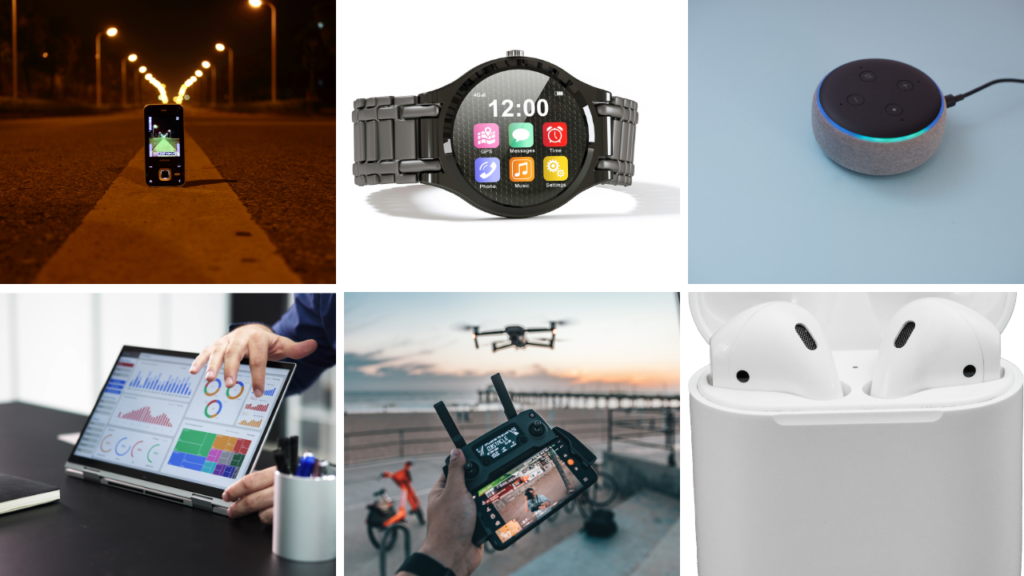
Most Innovative Gadgets of the Decade
The 2010s were a transformative period for consumer technology. Smartphones became more powerful, wearable devices moved from novelty products into everyday use, drones became easier to operate, and voice-controlled smart speakers entered homes.
Some gadgets were successful because they introduced genuinely useful technology. Others were important because they demonstrated an idea that later became common, even if the original product had limitations.
That distinction matters. Innovation does not always mean commercial success. A gadget can influence the direction of an industry without becoming a household name.
This article looks at 10 influential gadgets from roughly 2010 through 2019 and explains why they mattered.
The selection is based primarily on the supplied sources, particularly technology retrospectives and research discussing the development of electronic gadgets, displays, wearables, and emerging consumer technologies. The ranking is editorial rather than an objective scientific ranking.
What Makes a Gadget Innovative?
Before looking at individual devices, it helps to define innovation.
An innovative gadget may:
- Introduce a new technology to consumers.
- Make an existing technology easier to use.
- Create a new product category.
- Change how people interact with technology.
- Inspire competing products.
- Combine several technologies into one practical device.
- Demonstrate an idea that later becomes mainstream.
Innovation should therefore be judged by more than sales.
For example, a device may have limited commercial success but still influence future products. Google Glass is one example: its privacy and usability challenges helped expose important issues surrounding wearable and augmented-reality technology. NewsPoint’s retrospective similarly includes products such as Google Glass and the Segway among influential gadgets despite their limitations.
10 Most Innovative Gadgets of the 2010s
| Gadget | Approx. introduction | Main innovation | Lasting influence |
|---|---|---|---|
| Nokia Lumia 1020 | 2013 | Computational photography | Smartphone cameras |
| Pebble Smartwatch | 2013 | Smartphone-connected wearable | Modern smartwatches |
| Amazon Echo | 2014 | Consumer voice assistant | Smart homes |
| Microsoft Surface Pro 3 | 2014 | Laptop-tablet hybrid | 2-in-1 computers |
| DJI Phantom | 2013–2015 | Accessible consumer drones | Aerial photography |
| Dell XPS 13 | 2015 | Thin-bezel laptop design | Modern laptop design |
| Apple AirPods | 2016 | Truly wireless earbuds | Wireless audio |
| Fitbit Charge 2 | 2016 | Accessible fitness tracking | Wearable health technology |
| Oculus Rift | 2016 | Consumer virtual reality | VR development |
| iPhone X | 2017 | Face ID and modern smartphone design | Smartphone interfaces |
Dates and selections reflect the supplied technology retrospectives and are not intended to represent every important gadget released during the decade.
1. Nokia Lumia 1020: The Smartphone Camera Revolution
The Nokia Lumia 1020 was released in 2013 and became notable for the importance it placed on smartphone photography.
According to Gizmodo’s retrospective, the device demonstrated how smartphone manufacturers could make camera technology a central part of the phone rather than treating it as a secondary feature. Its camera and software also anticipated the growing importance of computational photography.
Why it mattered
Computational photography uses software to improve or combine information captured by a camera sensor.
Instead of relying entirely on a large traditional camera system, smartphones increasingly began using image processing to improve photographs.
This approach helped establish the smartphone as a serious everyday camera.
What it influenced
The broader trend eventually contributed to:
- Multiple smartphone cameras.
- Night photography modes.
- Computational image processing.
- Portrait effects.
- AI-assisted photography.
- Advanced smartphone video.
The Lumia 1020 therefore deserves recognition not simply because of its specifications, but because it helped highlight where smartphone cameras were heading.
2. Pebble Smartwatch: Making the Wrist a Second Screen
Smartwatches existed before Pebble, but the Pebble helped demonstrate a practical way to connect a watch to a smartphone.
The device could display notifications for messages, calls, and email while allowing users to keep their phones in their pockets. It also supported applications that expanded its functionality.
Why it mattered
The idea was simple:
Your wrist could become an extension of your phone.
That concept became an important part of the smartwatch category.
Modern wearables have expanded far beyond notifications. They can include activity tracking, sensors, navigation, communications, and health-related features.
Wearable technology is now a recognized technology category that includes smartwatches, activity trackers, wearable computers, and other electronic devices worn on or close to the body.
What it influenced
The Pebble concept helped establish expectations for:
- Smartphone notifications on the wrist.
- Customizable watch applications.
- Wearable interfaces.
- Activity tracking.
- Always-available information.
3. Amazon Echo: Bringing Voice Assistants Into the Home
The Amazon Echo helped make voice-controlled computing a practical consumer experience.
Gizmodo describes the Echo as an important turning point because it allowed users to interact with a digital assistant without constantly reaching for a smartphone. Functions included playing music, setting timers, answering questions, and controlling compatible smart-home devices.
Why it mattered
The important innovation was not simply the speaker.
It was the interface.
Instead of tapping a screen, users could speak naturally to a device.
That opened the door to voice-controlled:
- Lighting.
- Music.
- Timers.
- Information searches.
- Home automation.
- Connected appliances.
The larger impact
The Echo helped establish the smart speaker as a consumer gadget category and contributed to the broader development of connected homes.
Voice assistants are also an example of how technological innovation can involve software and user interaction as much as physical hardware.
4. Microsoft Surface Pro 3: Redefining the Laptop-Tablet Hybrid
The Microsoft Surface Pro 3 showed how a Windows tablet could be designed for more serious computing.
Gizmodo’s retrospective highlights the device’s move toward a full Windows operating system and laptop-class computing in a thin tablet-style design.
Why it mattered
The Surface Pro 3 addressed a practical problem:
Could one portable device serve as both a tablet and a computer?
Its design helped popularize the 2-in-1 concept.
For people who wanted portability but still needed desktop-style software, this form factor offered an alternative to carrying separate devices.
What it influenced
The broader category helped encourage:
- Detachable keyboards.
- Stylus-supported computing.
- Touchscreen laptops.
- Hybrid tablet-computer designs.
- Portable productivity devices.
The lesson was important: innovation can come from combining established technologies in a more useful form.
5. DJI Phantom: Making Consumer Drones More Accessible
Consumer drones became increasingly capable during the 2010s, and DJI’s Phantom series played a major role in making aerial photography accessible to a much wider audience.
Gizmodo notes that the Phantom became closely associated with consumer drones and evolved to include features such as an integrated high-definition camera, a three-axis gimbal, 4K video, and obstacle avoidance in later generations.
Why it mattered
Before accessible consumer drones, aerial photography generally required considerably more specialized equipment and expertise.
Camera-equipped drones changed that.
They created new possibilities for:
- Photography.
- Videography.
- Mapping.
- Inspection.
- Recreation.
- Research and other professional applications.
NewsPoint’s retrospective also highlights DJI’s use of computer vision and obstacle avoidance as an important development in making drones easier for novice users.
Important limitation
Drones are not simply recreational gadgets. Their use can involve aviation regulations, privacy concerns, safety requirements, and restrictions that vary by location.
6. Dell XPS 13: Changing Laptop Design
The Dell XPS 13, introduced in 2015, demonstrated how laptop manufacturers could dramatically reduce screen bezels while maintaining a compact computer design.
Gizmodo credited the XPS 13 with influencing how people viewed high-quality laptop design during the decade.
Why it mattered
A smaller bezel means less space is occupied by the border around the display.
That allows manufacturers to fit a larger screen into a relatively compact body.
The design direction became increasingly common across the laptop industry.
What it influenced
The broader trend contributed to laptops with:
- Narrow bezels.
- Larger displays in compact bodies.
- Thinner designs.
- More portable form factors.
This is an example of an innovation that may seem subtle but significantly affects everyday user experience.
7. Apple AirPods: Making Truly Wireless Audio Mainstream
Apple introduced AirPods in 2016.
Wireless earbuds already existed, but AirPods helped demonstrate how a truly wireless audio product could be integrated into a larger device ecosystem.
Gizmodo specifically highlighted the combination of wireless connectivity, the charging case, and Apple’s custom W1 chip as important aspects of the product’s experience.
Why it mattered
The major change was convenience.
There was no cable connecting the two earbuds.
The charging case also provided a simple way to store and recharge them.
What it influenced
The success of this product category encouraged widespread development of:
- Truly wireless earbuds.
- Compact charging cases.
- Wireless audio accessories.
- Touch and gesture controls.
- Noise-canceling earbuds.
AirPods are a useful example of a broader principle in consumer technology:
The best innovation is often not the most complicated technology—it is technology that removes friction from everyday tasks.
8. Fitbit Charge 2: Making Fitness Tracking More Practical
Fitbit had already entered the wearable market before the 2010s, but the Fitbit Charge 2 represented the development of the fitness tracker into a more capable everyday wearable.
Gizmodo highlighted its comfortable design, readable display, long battery life, notifications, and sleep-tracking capabilities.
Why it mattered
Fitness trackers helped turn personal activity data into something people could view regularly.
Instead of relying only on memory, users could see information such as:
- Steps.
- Activity.
- Sleep-related measurements.
- Exercise information.
Wearable technology has since expanded into much more sophisticated health and physiological monitoring.
Research reviews describe potential applications ranging from activity and sleep monitoring to cardiovascular, metabolic, neurological, and other health-related applications.
Evidence matters
It is important not to assume that every measurement from a consumer wearable is equivalent to a clinical measurement.
Current evidence shows potential for wearables in healthcare, but reliability, clinical integration, and interpretation remain important challenges. The U.S. Government Accountability Office specifically notes variation in reliability and difficulties integrating wearable data into clinical practice.
9. Oculus Rift: Bringing Virtual Reality Back Into Focus
Virtual reality had existed for decades, but the Oculus Rift helped demonstrate that high-quality consumer VR could become a realistic product category.
Gizmodo describes the Rift as an important milestone in modern VR development, helping launch a new period of consumer virtual-reality experimentation and software development.
Why it mattered
A VR headset can create the perception that the user is inside a digitally generated environment.
Instead of viewing a virtual world on a conventional screen, the user can look around the environment as though occupying a three-dimensional space.
Potential applications
VR has applications in areas such as:
- Gaming.
- Training.
- Simulation.
- Education.
- Design.
- Visualization.
However, the long-term success of VR remains dependent on factors including comfort, cost, content availability, ease of use, and practical value.
10. iPhone X and Face ID: Changing Smartphone Interaction
The iPhone X was one of the decade’s most influential smartphones.
Its introduction of Face ID demonstrated a different approach to biometric authentication and smartphone interaction.
Gizmodo included the iPhone X and Face ID among its notable gadgets of the decade.
Why it mattered
The device helped accelerate several trends already developing in smartphones:
- Reduced physical buttons.
- Larger edge-to-edge-style displays.
- Facial authentication.
- Gesture-based navigation.
- Greater reliance on software interfaces.
Smartphone design continued moving toward larger displays and new form factors throughout the decade.
Research on electronic gadgets also documents the development of curved and foldable smartphone displays, while noting that these technologies introduced their own challenges involving durability, grip, repair, user experience, and manufacturing.
Other Gadgets That Deserve Recognition
The 10 gadgets above are not the only important innovations of the decade.
Several other products and technologies deserve attention.
Google Glass
Google Glass demonstrated the possibilities and problems of wearable augmented-reality technology.
Its experience highlighted questions around privacy, social acceptance, usability, and how wearable computers should interact with their surroundings. NewsPoint includes Google Glass among influential gadgets while noting the privacy concerns surrounding the product.
Foldable Phones
Foldable smartphones represented another important hardware development.
Instead of treating the display as a rigid surface, manufacturers developed flexible display systems that could bend.
Research on foldable and curved displays identifies both opportunities and limitations, including durability, repair costs, ergonomics, interface design, and manufacturing challenges.
Foldable phones therefore represent an important innovation, but they should not automatically be considered superior to conventional smartphones.
How Gadgets From the 2010s Changed Everyday Life
The most important lesson from this decade is that gadgets increasingly became connected systems rather than isolated devices.
A modern gadget may combine:
- Hardware.
- Sensors.
- Wireless communication.
- Cloud services.
- Mobile applications.
- Artificial intelligence.
- Data processing.
- Voice or gesture interfaces.
Consider a smartwatch.
It may communicate with a smartphone, collect sensor information, synchronize data with online services, display notifications, and provide health or fitness features.
That is very different from the traditional idea of an electronic gadget performing one isolated function.
Four Major Trends That Defined the Decade
1. Smartphones Became Computing Platforms
Phones increasingly became cameras, navigation devices, entertainment systems, communication tools, payment devices, and productivity platforms.
The development of advanced displays and smartphone cameras further expanded what a pocket-sized computer could do.
2. Wearables Became More Capable
Smartwatches and fitness trackers transformed wearable technology from a novelty into an increasingly important consumer category.
Research describes wearable electronics as a growing platform for physiological monitoring and other applications, while also identifying technical and practical limitations.
Today, wearable technology can include devices designed to collect information about activity and physiological signals.
3. Homes Became More Connected
Smart speakers helped introduce voice control into ordinary households.
Connected lighting, thermostats, cameras, appliances, and entertainment devices expanded the concept of the smart home.
The important shift was from controlling each device independently toward creating systems in which multiple devices could communicate.
4. Physical Products Became More Software-Driven
Many modern gadgets are no longer finished when they leave the factory.
Software updates can change features, improve security, modify interfaces, and add capabilities.
This means the usefulness of a gadget can depend on both its physical hardware and the software ecosystem supporting it.
What About the Most Innovative Gadgets of the 2020s?
Although this article focuses on the 2010s, the next decade has continued several of the same trends.
Artificial intelligence, advanced wearables, robotics, spatial computing, connected devices, flexible displays, and other technologies are influencing gadget development.
However, predictions about which technologies will dominate the next decade should be treated carefully.
Technology forecasts describe possible directions rather than guaranteed outcomes.
For example, research on next-generation wearable electronics identifies promising applications in personalized health monitoring, assistive robotics, communication, and flexible electronics while also emphasizing technical constraints and future research needs.
How to Choose an Innovative Gadget Today
A gadget does not need to be revolutionary to be useful.
When evaluating a device, consider these factors:
1. Does it solve a real problem?
A long list of features does not automatically make a gadget useful.
2. Is it easy to use?
Good technology should reduce unnecessary complexity.
3. Does it work with your existing devices?
Compatibility can be more important than specifications.
4. How long will it receive software support?
A technically impressive device can become less useful if updates stop.
5. What happens to your data?
Devices with cameras, microphones, location services, and health sensors can collect sensitive information.
Check privacy settings and understand what information is collected and how it is used.
6. Is the technology mature?
New technology can be exciting but may have unresolved reliability, repairability, or compatibility problems.
7. Is the cost justified?
The newest gadget is not necessarily the best gadget for your needs.
Must-Have Gadgets for Every Home
If you are building a practical home technology setup, focus on gadgets that provide everyday value.
Consider:
- A reliable smartphone.
- A laptop or desktop computer.
- A quality Wi-Fi router.
- A power bank or backup charging solution.
- A smart speaker or voice assistant, if useful to your household.
- A streaming device or smart TV.
- A surge protector.
- A basic printer if you regularly print documents.
- A webcam or camera for remote communication.
- Smart-home devices that solve a specific problem.
The goal should not be to fill your home with technology.
The goal should be to choose devices that make communication, work, entertainment, safety, or daily tasks easier.
For a practical companion guide, see [Must-Have Gadgets for Every Home].
Best Gadgets for Beginners
People new to technology do not necessarily need the most advanced devices.
Beginners should generally prioritize:
- Simple interfaces.
- Reliable products.
- Good customer support.
- Strong compatibility.
- Easy setup.
- Clear instructions.
- Reasonable pricing.
- Essential features rather than unnecessary extras.
A beginner might start with a smartphone, wireless earbuds, a laptop, a power bank, or a simple smart-home device.
Once the basic technology becomes comfortable, more advanced gadgets can be added.
See [Best Gadgets for Beginners] for a beginner-friendly approach to choosing technology.
Frequently Asked Questions
What is the most innovative gadget of the decade?
There is no universally accepted single winner. Innovation can be measured by technical originality, consumer impact, usability, or influence on later products.
The smartphones, smart speakers, wearables, drones, wireless earbuds, and VR headsets discussed in this article each influenced different areas of consumer technology.
Which gadget changed smartphones the most?
Several products contributed to modern smartphone development. The iPhone X was particularly influential in areas such as facial authentication, gesture-based interaction, and display design, while devices such as the Nokia Lumia 1020 helped demonstrate the importance of advanced smartphone photography.
Are smartwatches actually useful?
They can be useful for notifications, activity tracking, communication, navigation, and other tasks.
Health-related features can also provide useful information, but consumer wearable measurements should not automatically be treated as medical diagnoses. Evidence and device performance vary by feature and device.
Are foldable phones better than regular phones?
Not necessarily.
Foldable phones can provide larger displays in compact folded designs, but research has identified challenges involving durability, weight, usability, repair, and display technology.
Whether a foldable phone is better depends on the user’s priorities.
Are drones considered gadgets?
Yes. Consumer drones are electronic devices that combine cameras, sensors, motors, wireless communication, software, and other technologies.
However, operating them can involve legal and safety requirements.
Why are wireless earbuds considered innovative?
Wireless earbuds helped remove physical cables from personal audio and made small, portable wireless listening more convenient.
Their broader influence can be seen in the growth of truly wireless audio products during and after the 2010s.
What should I look for when buying a gadget?
Start with your needs rather than the product’s feature list.
Consider usability, compatibility, reliability, software support, privacy, repairability, battery life, and total cost.
Final Thoughts
The most innovative gadgets of the 2010s were not necessarily the products with the most impressive specifications.
Their real importance came from changing what consumers expected from technology.
The Nokia Lumia 1020 helped emphasize computational photography. Pebble helped establish the smartwatch as a smartphone companion. Amazon Echo brought voice interaction into the home. DJI helped make aerial photography more accessible. AirPods popularized truly wireless personal audio. Fitbit helped expand consumer wearable tracking. Oculus Rift helped reignite consumer VR. And smartphones such as the iPhone X pushed new approaches to authentication and interaction.
Together, these products illustrate a larger transformation.
Technology became more portable, connected, intelligent, sensor-driven, and integrated into everyday life.
The next generation of gadgets will likely build on the same foundations while introducing new interfaces and capabilities.
But the central question should remain simple:
Does the technology genuinely make life better, easier, safer, more productive, or more enjoyable?
That is ultimately what makes a gadget worth adopting.
Sources:
- NewsPoint — The Decade-Defining Gadgets
- ResearchGate — The Advancement of Electronic Gadgets in 21st Century
- Gizmodo — The Most Innovative Gadgets of the Decade
- Reader’s Digest — Inventions That Changed the World in the Last Decade
- BBC Science Focus — The 25 Most Powerful Ideas of the 21st Century
- PubMed Central — Wearables and the Medical Revolution
- Forbes — The Biggest Technology Trends in the Next 10 Years
- ScienceDirect — Research on Emerging Electronic and Wearable Technologies