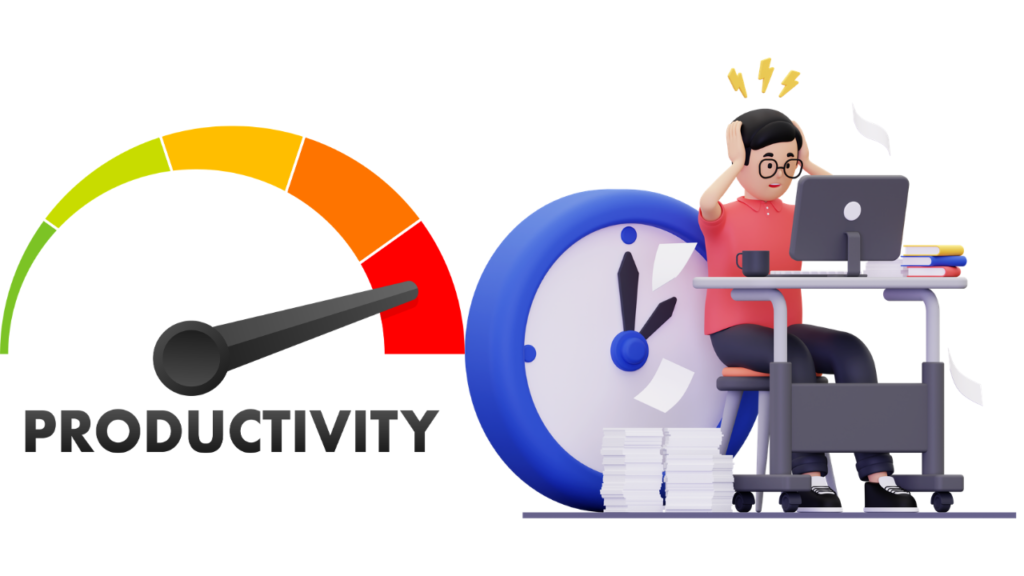
Productivity vs. Busyness: Understanding the Difference
Being busy can feel productive.
You may spend the day answering messages, attending meetings, checking email, completing small tasks, and moving from one responsibility to another. By the end of the day, you may feel exhausted and wonder why you completed so little meaningful work.
This is the difference between busyness and productivity.
Busyness describes being occupied with activities. Productivity focuses on achieving useful results with the time, attention, and resources available.
The two can happen at the same time, but they are not the same thing.
Research on busyness and productivity provides some support for this distinction, although the evidence should be interpreted carefully. One qualitative study involving 25 participants found that many participants viewed busyness and multitasking as barriers to productivity. However, the small, purposive sample means its findings should not be treated as universal evidence for everyone.
What Is Productivity?
Productivity generally refers to how effectively inputs such as time, effort, and resources are converted into useful outputs.
In everyday life, productivity does not necessarily mean doing more.
It can mean:
- Completing an important task.
- Making meaningful progress toward a goal.
- Solving a problem.
- Producing something useful.
- Completing work to an appropriate standard.
- Using your time according to your priorities.
For example, spending two focused hours completing an important project may be more productive than spending eight hours constantly switching between email, social media, meetings, and minor administrative tasks.
Productivity focuses on results
A productive day might therefore look relatively quiet.
You may complete only a few major tasks, but those tasks move an important goal forward.
The key question becomes:
What meaningful result did my work produce?
What Is Busyness?
Busyness is the condition of having many activities, responsibilities, or demands competing for your attention.
Being busy is not necessarily bad.
Parents, students, employees, business owners, caregivers, and professionals may all have legitimate reasons for having demanding schedules.
The problem occurs when activity becomes a substitute for meaningful progress.
Someone may spend hours organizing files, checking notifications, attending unnecessary meetings, or repeatedly switching between tasks without addressing the work that matters most.
That person may be extremely busy without being particularly productive.
Productivity vs. Busyness: Key Differences
| Productivity | Busyness |
|---|---|
| Focuses on meaningful results | Focuses on activity |
| Prioritizes important tasks | Often reacts to whatever demands attention |
| Measures progress toward goals | May measure how much was done |
| Allows focused work | Often involves frequent switching |
| Uses time intentionally | Can consume time without clear priorities |
| Includes rest and recovery | May encourage constant activity |
| Values effectiveness | Can create the appearance of effort |
The distinction is not absolute. A busy schedule can contain highly productive work, and productive work can sometimes require substantial effort.
The important issue is whether activity is contributing to a worthwhile outcome.
Why Being Busy Can Feel Productive
One reason busyness can be difficult to recognize is that activity creates visible evidence of effort.
You can see emails being answered.
You can see meetings on your calendar.
You can see tasks being checked off a list.
You can see notifications arriving.
These activities can create a feeling of progress even when the most important objective remains unfinished.
The 2017 study The Effect of Busyness on Productivity of an Individual specifically examined busyness, multitasking, and productivity through interviews with 25 participants. Its authors concluded that busyness itself should not be assumed to produce productivity. Because the research was qualitative and based on a small sample, its conclusion should be viewed as evidence from that particular study rather than a definitive rule for all people and workplaces.
The Problem With Multitasking
Multitasking is often associated with busyness.
When people multitask, they attempt to manage multiple activities within the same period. In practice, this can involve rapidly switching attention between tasks rather than giving each task sustained attention.
Research on workplace interruptions illustrates why this matters. In one empirical study, participants sometimes completed interrupted tasks faster, but the researchers also found greater stress, frustration, time pressure, and effort associated with the interruptions.
This means interruptions do not have a simple, universal effect.
The evidence is more nuanced than saying that every interruption automatically makes someone less productive.
For important work, however, protecting periods of focused attention can be a practical way to reduce unnecessary task switching.
Working Longer Does Not Automatically Mean Being More Productive
Another important distinction is between hours worked and productive output.
Economic research by Stanford economist John Pencavel found a nonlinear relationship between working hours and output. At lower levels of working time, additional hours can increase output, but beyond a threshold, output rises at a decreasing rate.
In other words, more hours do not necessarily produce proportionally more results.
Pencavel’s research also examined recovery from work. The findings indicate that insufficient recovery following long working periods can affect subsequent work performance.
This does not mean that everyone should work a particular number of hours.
Individual circumstances, occupations, workloads, health, and job requirements differ.
The broader lesson is simpler:
Longer hours should not automatically be treated as evidence of greater productivity.
Signs You May Be Busy Rather Than Productive
Consider your typical day.
You may be experiencing busyness rather than productive progress if you frequently:
- Start many tasks but finish few.
- Check email or messages repeatedly.
- Move between several tasks without completing important ones.
- Attend meetings that do not require your involvement.
- Spend excessive time organizing instead of executing.
- Say yes to nearly every request.
- Have a long task list but unclear priorities.
- Work for long periods without knowing what you accomplished.
- Feel constantly occupied but remain behind on important goals.
- Measure your day by activity rather than outcomes.
None of these behaviors automatically means you are unproductive.
They are signals worth examining.
Signs You Are Working Productively
Productive work tends to have clearer direction.
You may:
- Know what matters most today.
- Work on a limited number of priorities.
- Complete important tasks before less important ones.
- Protect time for focused work.
- Reduce unnecessary interruptions.
- Review what you accomplished.
- Adjust your priorities when circumstances change.
- Leave room for rest and recovery.
- Understand how individual tasks connect to larger goals.
Productivity is therefore less about maintaining constant activity and more about directing effort toward worthwhile outcomes.
How to Become More Productive Without Simply Doing More
1. Identify your most important task
At the beginning of the day, identify the task that would make the biggest meaningful contribution to your current goal.
Do that task before allowing lower-priority activities to dominate your attention when possible.
2. Separate urgent from important
Urgent tasks demand attention quickly.
Important tasks contribute to longer-term goals.
They are not always the same thing.
An overflowing inbox may feel urgent, while studying for an examination, completing a project, or planning a business may be more important.
3. Limit unnecessary multitasking
Try grouping similar activities together.
For example, instead of checking email every few minutes, designate specific periods for handling messages.
This can reduce unnecessary switching and make it easier to protect focused work.
4. Define what “done” means
Vague goals can encourage endless activity.
Instead of saying:
“Work on the project.”
Define a specific outcome:
“Complete the introduction and review the first three sections.”
A clear endpoint makes progress easier to recognize.
5. Use your calendar intentionally
A calendar should not simply show how busy you are.
Use it to protect time for important activities.
Consider scheduling:
- Focused work.
- Administrative tasks.
- Meetings.
- Exercise or movement.
- Meals.
- Family responsibilities.
- Personal time.
- Rest.
A completely full calendar can leave little room for unexpected demands or recovery.
6. Learn to say no
Every commitment consumes some combination of time, attention, energy, or resources.
Before accepting another task, ask:
Does this support an important responsibility or goal?
If not, consider declining, postponing, delegating, or simplifying it when appropriate.
7. Review your results
At the end of the day or week, ask:
- What did I complete?
- What meaningful progress did I make?
- What consumed most of my time?
- Which activities were necessary?
- Which activities could be reduced?
- What should I prioritize next?
This turns productivity into an ongoing learning process rather than a race to stay busy.
Productivity Does Not Mean Doing Nothing Else
A common misconception is that productivity requires working continuously.
It does not.
Rest, meals, relationships, recreation, sleep, exercise, and personal responsibilities are not necessarily wasted time.
For many people, sustainable productivity requires periods away from demanding work.
Research on recovery from work supports the idea that time away from work can help restore physical, mental, and emotional capacity, although the specific amount of recovery needed varies between individuals and circumstances.
Productivity should therefore be considered within the context of a person’s overall life.
A Simple Productivity Test
When you are unsure whether you are being productive, ask yourself five questions:
- What am I trying to accomplish?
- Why does it matter?
- What is the most important next step?
- Is what I am doing helping me move toward that outcome?
- What can I stop, postpone, delegate, or simplify?
These questions can help shift attention from activity to outcomes.
Busy vs. Productive: A Practical Example
Imagine two people preparing for an important examination.
Person A spends six hours studying. During that time, they frequently check their phone, reorganize notes, answer messages, watch unrelated videos, and switch between several subjects.
Person B studies for a shorter, defined period. They choose specific topics, remove unnecessary distractions, work through practice questions, and review areas they do not understand.
Person A may feel busier.
Person B may make more targeted progress.
The example does not prove that shorter study sessions are always better. Instead, it illustrates the central distinction: time spent is not the same thing as meaningful progress.
Frequently Asked Questions
Is being busy the same as being productive?
No.
Busyness describes activity or occupation. Productivity focuses more on meaningful results.
A person can be busy and productive, busy and unproductive, or relatively unbusy while making substantial progress on an important task.
Why do I feel productive when I am busy?
Completing small tasks and responding to demands can create a visible sense of activity.
However, activity does not necessarily mean that your highest-priority goals are progressing.
Reviewing outcomes can help distinguish the two.
Is multitasking bad for productivity?
Not necessarily in every situation.
The effects depend on the tasks and circumstances. Research on interruptions shows that people may sometimes compensate by working faster, but this can involve greater stress, frustration, time pressure, and effort.
For complex tasks, minimizing unnecessary switching is a reasonable productivity strategy.
Does working longer make you more productive?
Not indefinitely.
Research on working hours indicates that output can increase at a decreasing rate as working hours rise beyond a certain threshold.
The relationship between hours and productivity varies by work, person, and circumstances.
How can I stop being busy all the time?
Start by identifying your most important priorities.
Then reduce unnecessary commitments, limit distractions, group similar tasks, protect focused work periods, and regularly review where your time is going.
Can rest improve productivity?
Adequate recovery is important for sustainable performance.
Research by Pencavel found evidence that insufficient recovery after long working periods can negatively affect subsequent work performance.
Rest should therefore not automatically be viewed as the opposite of productivity.
The Bottom Line
Busyness is about being occupied. Productivity is about making meaningful progress.
You do not need to fill every hour with activity to have a productive day.
Instead, focus on the outcomes that matter, prioritize important work, reduce unnecessary task switching, and make room for recovery.
The goal is not simply to do more.
The goal is to use your time and attention effectively on what matters most.
Sources
- Bharath, V. V., Chamoli, D., Kumar, R., & Shankar, R. (2017). The Effect of Busyness on Productivity of an Individual. International Journal of Indian Psychology.
- Pencavel, J. H. The Productivity of Working Hours. The Economic Journal.
- Pencavel, J. H. Recovery from Work and the Productivity of Working Hours. Economica.
- Mark, G., Gudith, D., & Klocke, U. The Cost of Interrupted Work: More Speed and Stress.