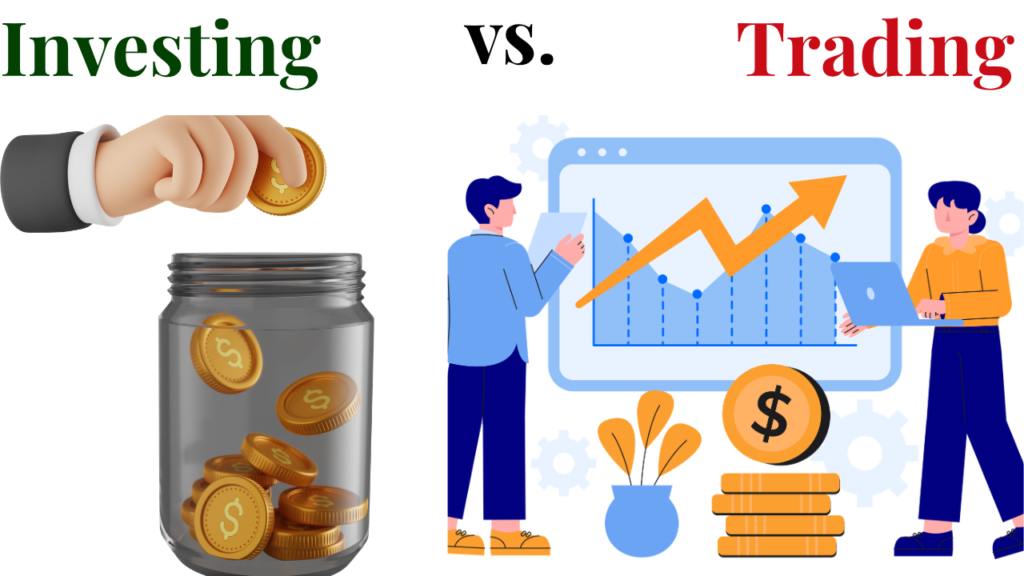
Investing vs. Trading: What’s the Difference?
Investing and trading both involve buying and selling financial assets, but they generally approach money management in very different ways.
Investing typically focuses on building wealth over a longer period. Investors may hold stocks, bonds, mutual funds, ETFs, or other assets for years or decades.
Trading generally focuses on shorter-term price movements. Traders may buy and sell financial assets over days, weeks, months, or even within the same day.
The biggest difference is therefore not simply what you buy. It is often how long you intend to hold it, why you are buying it, and how actively you manage the position.
Neither approach guarantees a profit.
Both involve risk, and either approach can result in losses.
Investing vs. Trading at a Glance
| Feature | Investing | Trading |
|---|---|---|
| Primary focus | Long-term wealth building | Shorter-term price movements |
| Typical holding period | Years or decades | Days, weeks, months, or sometimes minutes |
| Decision-making | Often based on long-term goals and fundamentals | Often focused on price movements, market conditions, and trading strategies |
| Activity level | Usually lower | Usually higher |
| Portfolio approach | Often diversified | Can be more concentrated, depending on strategy |
| Market monitoring | Usually less frequent | Often more frequent |
| Risk | Market risk remains | Can involve substantial short-term risk |
| Time commitment | Generally lower | Can be significantly higher |
| Main objective | Build wealth over time | Seek potential short-term profits |
These are general distinctions. Individual investors and traders may use strategies that do not fit neatly into either category.
What Is Investing?
Investing means purchasing assets with the expectation that they may increase in value or generate income over time.
Examples include:
- Stocks
- Bonds
- Mutual funds
- Exchange-traded funds (ETFs)
- Real estate
- Other investment products
Investor.gov explains that investment returns can come from an increase in an asset’s value, interest, or dividend payments. It also emphasizes that all investments involve risk.
For many people, investing is connected to long-term financial goals such as:
- Retirement
- Building wealth
- Buying a home
- Education
- Creating future financial security
The longer time horizon can allow investors to focus less on daily price movements and more on the underlying purpose of the portfolio.
What Is Trading?
Trading involves buying and selling financial assets with the goal of attempting to profit from shorter-term price movements.
A trader might buy a stock because they believe its price could rise in the near future.
Another trader might sell or take a short position because they expect a price decline, depending on the strategy and account permissions involved.
Trading can involve:
- Stocks
- ETFs
- Bonds
- Commodities
- Options
- Other financial instruments
Trading generally requires more active decision-making than traditional long-term investing.
Fidelity describes trading as an active strategy that can involve buying and selling investments multiple times within a day, week, or month.
How Long Do Investors and Traders Hold Investments?
Time horizon is one of the clearest differences.
Investors
An investor may purchase an asset intending to hold it for many years.
For example, someone saving for retirement might contribute regularly to a diversified portfolio and allow the investments to remain in the account through different market conditions.
Investor.gov identifies long-term investing as an approach commonly used for goals such as retirement and education.
Traders
A trader may hold an asset for a much shorter period.
A position could be held for:
- Minutes
- Hours
- Days
- Weeks
- Months
The exact period depends on the trading strategy.
The shorter the time frame, the more important short-term market movements can become.
Investing Is Usually Goal-Driven
Long-term investing typically starts with a financial goal.
For example:
“I want to build money for retirement over the next 20 years.”
That goal can influence:
- How much you invest
- Your asset allocation
- Your risk tolerance
- Your time horizon
- How often you review your portfolio
Investor.gov recommends defining financial goals and creating a plan for regularly setting aside money for investments.
This is different from making a trade simply because you expect an asset’s price to move in a particular direction.
Trading Is Usually More Active
Trading requires more frequent decisions.
A trader may need to determine:
- When to enter a position
- When to exit
- How much capital to risk
- What price movements matter
- Whether market conditions have changed
- How to manage potential losses
This can require significant time, knowledge, discipline, and risk management.
More activity does not automatically mean better results.
In fact, frequent trading can introduce additional transaction costs, taxes, and opportunities for emotional decision-making.
How Do Investors Make Money?
Investors can potentially earn returns in several ways.
Capital Appreciation
An asset increases in value.
Dividends
Some stocks and funds distribute income to investors.
Interest
Certain bonds and other investments may pay interest.
Compounding
Returns that remain invested can potentially generate additional returns over time.
Investor.gov explains that compound growth occurs when returns are earned on both the original investment and accumulated returns.
However, investment returns are not guaranteed.
How Do Traders Try to Make Money?
Traders generally attempt to profit from changes in market prices.
For example, a trader might purchase an asset at one price and attempt to sell it at a higher price.
Some trading strategies also attempt to profit from declining prices.
Traders may use methods such as:
- Technical analysis
- Price charts
- Market trends
- Trading volume
- Fundamental information
- Economic news
- Defined entry and exit rules
These methods can be complex, and none guarantees a profitable outcome.
Investing and Trading Both Involve Risk
One of the biggest mistakes beginners make is assuming that investing is safe while trading is risky.
The more accurate view is:
Both involve risk. The type, timing, and degree of risk can differ.
Investor.gov states that all investments involve risk and that market values can fluctuate.
An investor can lose money because a company’s stock declines, an industry struggles, interest rates change, or broader markets fall.
A trader can also lose money if a short-term price movement goes against their position.
Why Trading Can Require More Attention
Long-term investing generally allows investors to tolerate more short-term price fluctuations when their financial goals are far away.
Trading is different.
A trader attempting to profit from a short-term movement may need to pay close attention to price changes and market conditions.
This can make trading more demanding in terms of:
- Time
- Research
- Monitoring
- Decision-making
- Risk management
- Emotional discipline
That does not mean every trading strategy requires constant monitoring. The amount of attention depends on the strategy.
Diversification: A Major Difference in Approach
Diversification means spreading investments across different assets rather than depending heavily on one investment.
For long-term investors, diversification can be an important part of managing portfolio risk.
Investor.gov explains that asset allocation involves dividing investments among asset classes such as stocks, bonds, and cash, while diversification involves spreading investments among different assets.
A trader, however, may deliberately take a more concentrated position because the strategy is based on a particular short-term opportunity.
That concentration can increase exposure to losses.
Diversification does not eliminate risk or guarantee profits.
What About Investment Costs?
Costs matter for both investing and trading.
Potential costs can include:
- Fund expenses
- Advisory fees
- Trading-related costs
- Bid-ask spreads
- Account fees
- Taxes
The effect of costs can be particularly important when transactions occur frequently.
For long-term investors, recurring fund and account expenses can also reduce the amount of money that remains invested.
Investors should understand the costs associated with a financial product or strategy before committing money.
Investing vs. Trading: Which Requires More Time?
Generally, trading requires more active involvement than a traditional long-term investment strategy.
An investor may establish a diversified portfolio and review it periodically.
A trader may spend considerable time researching markets, identifying opportunities, entering positions, monitoring them, and deciding when to exit.
This is an important consideration for adults between 35 and 70 who may have careers, businesses, families, or other responsibilities.
Your available time is part of your financial decision.
Which Approach Is Better for Building Long-Term Wealth?
For someone whose primary objective is long-term wealth building, long-term investing is generally the more relevant framework to study first.
Investor.gov emphasizes regular investing, time, compound growth, asset allocation, and diversification as important concepts for long-term wealth building.
This does not mean trading can never be appropriate.
It means the two activities have different objectives and risk characteristics.
Someone considering trading should understand that short-term speculation is fundamentally different from building a diversified portfolio for a long-term financial goal.
Which Approach Is Better for Beginners?
For many beginners, learning the fundamentals of long-term investing can provide a useful foundation before considering active trading.
Start by understanding:
- Financial goals
- Time horizon
- Risk tolerance
- Asset allocation
- Diversification
- Investment fees
- Taxes
- Different investment products
FINRA’s investor education resources similarly emphasize understanding your financial situation, investment objectives, risk, diversification, and investment products before making decisions.
Trading can then be studied separately if you are interested in the additional risks and responsibilities involved.
Could You Both Invest and Trade?
Yes.
Some people maintain a long-term investment portfolio while also allocating a smaller portion of their money to active trading.
However, these activities should not be confused.
A long-term retirement portfolio and a speculative trading account can have completely different objectives.
If someone chooses to do both, it is important to understand:
- How much money is allocated to each activity
- The risks involved
- The costs
- The tax implications
- Whether trading losses could interfere with long-term financial goals
Money needed for essential expenses or near-term financial obligations should not be treated as trading capital simply because a potential opportunity appears attractive.
Questions to Ask Before Choosing
Before deciding whether investing or trading fits you, ask yourself these questions.
1. What is my financial goal?
Are you trying to build retirement savings or generate short-term trading profits?
2. When will I need the money?
A long-term retirement goal has a very different time horizon from money needed next year.
3. How much risk can I tolerate?
Think about how you would react if your account declined substantially.
4. How much time can I devote?
Trading can require substantially more attention than a conventional long-term investment strategy.
5. Do I understand what I am buying?
Never assume that an investment is appropriate simply because someone else is making money from it.
6. Can I afford to lose the money?
Investment and trading capital should not be confused with money needed for rent, food, emergency expenses, or other essential obligations.
7. Do I have a written strategy?
A clear plan can help prevent decisions driven by fear, excitement, or market hype.
Investing vs. Trading for People Over 50
Starting later in life does not automatically mean you should avoid investing.
However, the financial consequences of losses can be different when you have fewer years before you need your money.
Consider:
- Your retirement timeline
- Current savings
- Expected income
- Social Security and other retirement income
- Debt
- Emergency savings
- Investment risk
- How much time remains before withdrawals begin
Investor.gov notes that starting later can require larger contributions to reach long-term financial goals.
For people approaching retirement, preserving sufficient liquidity and aligning investments with the timing of future withdrawals can become increasingly important.
Common Mistakes to Avoid
Whether you invest or trade, several mistakes can undermine your financial plan.
Mistake 1: Confusing Trading With Investing
Buying a stock does not automatically make the activity long-term investing.
Your strategy and holding period matter.
Mistake 2: Chasing Quick Profits
The possibility of making money quickly can encourage people to take risks they do not fully understand.
Mistake 3: Ignoring Diversification
Putting a large percentage of your money into one investment can expose your portfolio to concentrated risk.
Mistake 4: Ignoring Fees
Frequent transactions and ongoing investment expenses can affect overall returns.
Mistake 5: Following Social-Media Tips Blindly
An investment recommendation should not replace your own research.
Mistake 6: Investing Money You Cannot Afford to Lose
Your investment strategy should fit your broader financial situation.
Mistake 7: Letting Emotions Control Decisions
Fear can encourage selling at an unfavorable time, while excitement can encourage buying after prices have already risen.
A written plan can help create a more disciplined process.
A Simple Decision Framework
Use this framework as an educational starting point.
| If your priority is… | You may want to learn more about… |
|---|---|
| Retirement over many years | Long-term investing |
| Building a diversified portfolio | Asset allocation and diversification |
| Regular contributions | Long-term investment strategies |
| Learning about companies | Fundamental investing |
| Short-term price opportunities | Trading |
| Frequent buying and selling | Active trading |
| Spending significant time monitoring markets | Trading strategies |
| Minimizing unnecessary activity | Long-term investing |
This table is not a personalized recommendation. Your circumstances, risk tolerance, financial goals, and investment knowledge all matter.
So, Which Approach Is Right for You?
There is no universal answer.
The better question is:
Which approach matches your goals, time horizon, risk tolerance, financial situation, and willingness to spend time managing money?
Long-term investing may make more sense if you:
- Are focused on retirement or another long-term goal
- Prefer a less active approach
- Want to build a diversified portfolio
- Have a long time horizon
- Do not want to monitor markets constantly
- Prefer regular contributions and long-term planning
Trading may appeal to you if you:
- Are interested in active market participation
- Understand that short-term price movements can be unpredictable
- Have time to research and monitor positions
- Understand the risks of active trading
- Have a clearly defined trading strategy
- Can afford losses without compromising essential financial goals
Interest in trading alone is not enough.
You need to understand the risks before putting money at stake.
Frequently Asked Questions
Is investing safer than trading?
Not automatically.
Investing and trading both involve risk. However, long-term investing and short-term trading expose investors to different types of decisions and time horizons.
Is trading the same as investing?
No.
Both involve buying and selling financial assets, but investing generally focuses on longer-term goals while trading typically focuses on shorter-term price movements.
Can you make more money trading than investing?
It is possible for an individual trade to generate a large return, but that does not mean trading consistently produces better results.
Returns depend on the strategy, market conditions, risk, costs, taxes, and individual decisions.
There is no guaranteed method for earning more money through trading.
Is long-term investing better for retirement?
Long-term investing is commonly used for retirement because retirement is generally a long-term financial goal.
Investor.gov highlights long-term investing, regular contributions, diversification, and retirement accounts as important components of long-term financial planning.
The appropriate strategy still depends on an individual’s circumstances.
Can I trade stocks inside a retirement account?
The answer depends on the type of retirement account, the assets involved, and the rules of the account provider.
Tax and trading rules can change, so verify current rules with the account provider and qualified tax or financial professionals when appropriate.
Do traders need more money than investors?
Not necessarily.
Account requirements vary by broker, investment product, and strategy.
The amount of money someone needs should not be confused with the amount they can afford to risk.
Can beginners start trading?
Beginners can study trading, but they should understand the risks before committing money.
Learning how markets work, understanding order types, researching investments, and practicing risk management are important foundations.
Can I invest without trading?
Yes.
An investor can build and maintain a long-term portfolio without frequently buying and selling investments.
Many long-term strategies emphasize regular contributions, diversification, and periodic review rather than constant trading.
The Bottom Line
Investing and trading are not the same thing.
Investing generally emphasizes long-term wealth building, while trading generally emphasizes shorter-term price movements.
The right approach depends on what you are trying to accomplish.
For long-term goals such as retirement, learning about asset allocation, diversification, regular investing, compound growth, and investment costs can provide a strong foundation.
For those interested in trading, it is equally important to understand that active trading can require more time, more frequent decisions, and careful risk management.
The goal should not be to choose whichever approach sounds more exciting.
The goal is to choose—or study—the approach that fits your financial objectives, time horizon, risk tolerance, knowledge, and available time.
Important: This article is for educational purposes only. It is not personalized financial, investment, or tax advice. Investment and trading decisions involve risk, and past performance does not guarantee future results.
Sources:
- Investor.gov — Introduction to Investing
- Fidelity — Trading vs. Investing
- FINRA — Investing Basics
- Fidelity — Investing Basics
- iShares — How to Invest