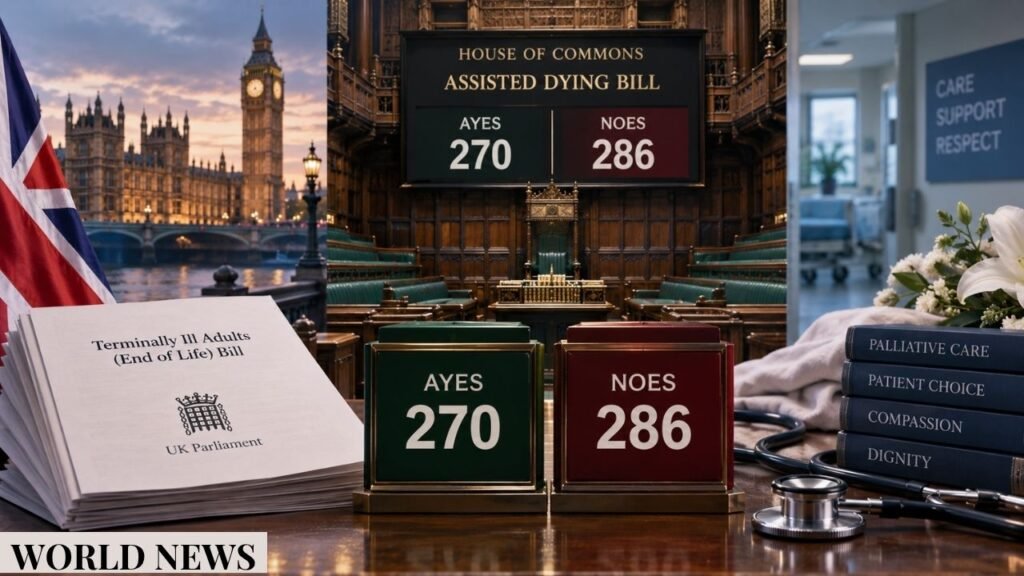
London, September 11, 2026 — Members of the UK House of Commons have rejected a bill that would have introduced a legal framework for assisted dying for some terminally ill adults in England and Wales, voting 286 to 270 against the measure at second reading.
The 16-vote defeat on Friday ends the bill’s progress through Parliament during the current session and reverses the Commons’ position on a similar proposal that passed in the previous Parliament.
The Terminally Ill Adults (End of Life) Bill, introduced by Labour MP Lauren Edwards, sought to allow eligible terminally ill adults to request assistance to end their own lives, subject to safeguards and protections.
The vote followed several hours of emotionally charged debate in which MPs raised competing concerns about personal choice, medical safeguards, protection of vulnerable people and the quality of end-of-life care.
Commons Rejects the Bill 286 to 270
The bill was defeated by 286 votes to 270, a majority of 16 against.
The official parliamentary voting record confirms the division took place on September 11, with 270 MPs voting in favour and 286 against.
Because the bill failed at second reading, it will not move to committee, report stage or third reading in the Commons during this parliamentary session.
The result represents a reversal from June 2025, when the previous version of the legislation passed its third reading in the Commons by 314 votes to 291. That earlier bill subsequently failed to complete its passage through the House of Lords before the end of the parliamentary session.
What the Assisted Dying Bill Proposed
The 2026-27 bill was presented by Lauren Edwards, the Labour MP for Rochester and Strood, after she was drawn second in the private members’ bill ballot.
Its stated purpose was to allow terminally ill adults, subject to safeguards and protections, to request and receive assistance to end their own lives.
The proposal was designed for England and Wales rather than the entire United Kingdom.
Under the bill, assistance provided within the proposed legal framework would not have resulted in criminal liability. Assistance outside that framework would have remained subject to the existing law on encouraging or assisting suicide.
Why Did MPs Reject the Bill?
The Commons debate exposed several areas of disagreement.
Opponents argued that the proposed safeguards were not sufficient and questioned whether the legislation could adequately protect vulnerable people.
Concerns also focused on the practical difficulties surrounding terminal illness, including medical judgments about life expectancy and whether people could make decisions free from pressure.
Another major issue was the state of palliative and end-of-life care.
Some MPs argued that Parliament should concentrate first on improving hospice, palliative and adult social care rather than changing the law on assisted dying.
Supporters, meanwhile, argued that terminally ill adults should have greater control over decisions concerning the end of their lives and maintained that a legal framework with safeguards could provide that choice.
Government Remained Neutral
The government did not take a collective position for or against the legislation.
In a written parliamentary answer on September 8, Justice Minister Sarah Sackman said:
“The Government is neutral on assisted dying and the Terminally Ill Adults (End of Life) Bill.”
She added that the government had a responsibility to help ensure that legislation passing through Parliament would be workable, effective and enforceable.
Prime Minister Andy Burnham also did not vote in the division, according to reporting by Reuters. His position was that palliative and adult social care should be strengthened before assisted dying legislation was introduced.
A Second Parliamentary Setback
Friday’s vote was not the first time MPs have considered legislation on assisted dying in recent years.
The previous Terminally Ill Adults (End of Life) Bill, introduced by Labour MP Kim Leadbeater, passed the Commons in June 2025.
It then moved to the House of Lords but did not complete all its stages before the parliamentary session ended. As a result, it fell without becoming law.
Lauren Edwards subsequently brought forward the 2026-27 bill, describing it as a reintroduction of the earlier proposal.
That attempt has now also been stopped in the Commons.
What Happens Next?
The bill cannot progress further during the current parliamentary session after its defeat at second reading.
The vote does not itself permanently settle the wider question of assisted dying in the United Kingdom. Future governments or MPs could introduce new legislation in a later Parliament.
However, any future proposal would need to go through the parliamentary process again unless a different constitutional route were available.
The immediate political debate is therefore likely to shift toward end-of-life care, palliative services and the safeguards that would be required if Parliament considers assisted dying legislation again.
Debate Over Choice and Protection Continues
The assisted-dying debate remains divided between two central concerns.
Supporters emphasize autonomy and the ability of terminally ill people to make decisions about the final stages of their lives.
Opponents emphasize protection, medical uncertainty and the potential risks to people who may be vulnerable to pressure.
Friday’s vote demonstrated that neither side has secured a lasting parliamentary consensus.
For now, assisted dying will remain outside the law in England and Wales, while the broader debate over how Britain should approach terminal illness and end-of-life care continues.
Editorial note: This article reports on parliamentary proceedings and does not advocate for or against assisted dying.
FAQ Section
What happened to the UK assisted dying bill?
The House of Commons rejected the Terminally Ill Adults (End of Life) Bill at second reading on September 11, 2026, by 286 votes to 270.
What did the assisted dying bill propose?
The bill proposed allowing terminally ill adults in England and Wales, subject to safeguards and protections, to request and receive assistance to end their own lives.
Who introduced the 2026 assisted dying bill?
The bill was introduced by Lauren Edwards, Labour MP for Rochester and Strood. She presented it in June 2026 after being drawn second in the private members’ bill ballot.
Why did the bill fail?
MPs opposing the bill raised concerns including the adequacy of safeguards, protection of vulnerable people, medical judgments about terminal illness and the condition of palliative and end-of-life care. Supporters argued for greater choice for terminally ill people.
Did assisted dying become legal in England and Wales?
No. The bill’s defeat means the proposed legal framework did not become law.
Has the House of Commons previously supported assisted dying legislation?
Yes. A previous version of the Terminally Ill Adults (End of Life) Bill passed its third reading in the Commons in June 2025 by 314 votes to 291, but it did not complete its passage through the House of Lords before that parliamentary session ended.