
Acquiring Tools, Equipment, and Infrastructure for Farming
Successful farming requires careful planning for tools, machinery, buildings, utilities, and infrastructure. Some investments are essential before planting or raising livestock, while others can be added as the farm expands over the next several years.
1. Immediate Infrastructure Needs (Before Operations Begin)
These are the essential facilities and systems required to start farming.
Land Preparation
- Land clearing
- Stump and rock removal
- Soil testing
- Land leveling
- Fencing
- Drainage improvements
- Farm road construction
Water Supply
- Borehole or well
- Irrigation system
- Water storage tanks
- Pumps
- Pipelines
- Rainwater harvesting system
Electricity
- Grid connection
- Solar power system
- Backup generator
- Electrical wiring
- Outdoor lighting
Farm Buildings
- Equipment storage shed
- Workshop
- Chemical and fertilizer storage
- Seed storage room
- Office
- Staff restroom
- Break room
Security
- Perimeter fencing
- Gates
- Security cameras
- Motion lights
- Alarm system
2. Essential Farm Equipment
Land Preparation Equipment
| Equipment | Purpose | Priority |
|---|---|---|
| Tractor | Field operations | High |
| Disc Plow | Primary tillage | High |
| Disc Harrow | Soil preparation | High |
| Rotary Tiller | Seedbed preparation | High |
| Box Blade | Land leveling | Medium |
Planting Equipment
| Equipment | Purpose |
|---|---|
| Seed Drill | Row planting |
| Planter | Precision planting |
| Transplanter | Vegetable crops |
| Fertilizer Spreader | Fertilizer application |
Crop Maintenance Equipment
- Boom sprayer
- Backpack sprayers
- Weeders
- Cultivators
- Pruning tools
- Irrigation timers
- Moisture meters
Harvest Equipment
- Combine harvester (grain farms)
- Vegetable harvest carts
- Fruit picking ladders
- Grain trailers
- Produce bins
Post-Harvest Equipment
- Washing station
- Sorting tables
- Grading equipment
- Packaging machine
- Cold storage
- Refrigerated truck (if needed)
3. Livestock Infrastructure (If Applicable)
Buildings
- Barn
- Poultry house
- Piggery
- Dairy barn
- Goat shelter
- Sheep barn
- Feed storage
- Hay storage
Equipment
- Feed mixers
- Water troughs
- Automatic feeders
- Milking machines
- Egg collection systems
- Livestock scales
4. Repair Existing Infrastructure
Inspect and repair:
- Farm fences
- Barn roofs
- Irrigation pipes
- Water pumps
- Wells
- Gates
- Farm roads
- Culverts
- Electrical wiring
- Drainage ditches
- Storage buildings
- Greenhouses
5. Technology Infrastructure
Modern farms benefit from:
- Farm management software
- GPS guidance
- Drones
- Weather stations
- Soil moisture sensors
- CCTV
- Wi-Fi coverage
- Livestock monitoring systems
6. Expansion Needs (1–5 Years)
As production grows, additional infrastructure may be needed.
Year 1
- Larger equipment shed
- Additional irrigation zones
- More fencing
- Greenhouse
- Additional water tanks
Year 2
- Cold room
- Grain silo
- Additional tractor
- Larger workshop
- Packing house
Year 3
- Solar power expansion
- Automated irrigation
- Larger warehouse
- Farm office
- Livestock expansion
Year 4
- New production fields
- Additional greenhouses
- Processing facility
- Refrigerated storage
- Delivery truck
Year 5
- Farm store
- Value-added processing plant
- Expanded cold chain
- Employee housing
- Visitor center or agritourism facilities
7. Maintenance Schedule
Maintain equipment regularly to maximize lifespan and reduce downtime.
| Item | Maintenance Frequency |
|---|---|
| Tractor | Every 250 operating hours |
| Irrigation Pumps | Monthly |
| Farm Roads | Annually |
| Greenhouses | Before each growing season |
| Water Tanks | Every 6 months |
| Fencing | Quarterly |
| Barns | Annually |
| Solar Panels | Every 3–6 months |
| Cold Room | Every 6 months |
| Sprayers | After each use |
8. Sample Five-Year Infrastructure Budget
| Year | Major Investment | Estimated Cost (USD) |
|---|---|---|
| Start-Up | Tractor, irrigation, fencing, storage shed | $80,000 |
| Year 1 | Greenhouse, water tanks, security | $30,000 |
| Year 2 | Cold room, packing house, second tractor | $95,000 |
| Year 3 | Solar system, warehouse, automation | $120,000 |
| Year 4 | Processing facility, delivery truck | $180,000 |
| Year 5 | Farm store, expanded production | $250,000 |
9. Infrastructure Planning Checklist
Immediate Priorities
- ✓ Clear and prepare land
- ✓ Test soil
- ✓ Install water supply
- ✓ Set up irrigation
- ✓ Build equipment shed
- ✓ Install perimeter fencing
- ✓ Connect electricity or solar power
- ✓ Purchase essential machinery
- ✓ Build secure chemical and fertilizer storage
- ✓ Establish farm access roads
Future Priorities
- □ Expand irrigation system
- □ Build cold storage
- □ Add packing and processing facilities
- □ Install renewable energy systems
- □ Increase storage capacity
- □ Purchase additional machinery
- □ Develop value-added processing
- □ Improve logistics and transportation
- □ Construct employee facilities
- □ Add precision agriculture technologies
A phased approach—starting with essential infrastructure and equipment, then expanding as revenue grows—helps control costs while creating a farm that is efficient, productive, and ready for long-term growth.
Prioritized List of Tools, Equipment, and Infrastructure for a Farm Enterprise
A prioritized equipment plan helps ensure that the most essential items are acquired first, while delaying non-critical purchases until the farm generates sufficient income. The following list is organized into three priority levels.
Priority 1: Essential (Required Before Operations Begin)
These items are necessary to establish and operate the farm safely and efficiently.
Infrastructure
- Farm land
- Perimeter fencing and gate
- Farm access road
- Borehole, well, or reliable water source
- Water storage tanks
- Irrigation system (drip, sprinkler, or pivot)
- Equipment and tool storage shed
- Chemical and fertilizer storage room
- Electricity or solar power system
- Security lighting and locks
Hand Tools
| Tool | Purpose |
|---|---|
| Shovels | Digging and loading soil |
| Hoes | Weeding and cultivating |
| Garden rakes | Soil preparation |
| Spades | Planting and edging |
| Wheelbarrows | Transporting materials |
| Pruning shears | Pruning crops |
| Machetes | Clearing vegetation |
| Measuring tape | Field layout |
| Soil probe | Soil sampling |
| Watering cans | Manual irrigation |
Machinery
| Equipment | Purpose |
|---|---|
| Tractor (40–75 HP) | Primary field operations |
| Disc plow | Primary tillage |
| Disc harrow | Secondary tillage |
| Rotary tiller | Seedbed preparation |
| Trailer | Hauling materials |
| Backpack sprayers | Pest and weed control |
| Water pump | Irrigation |
Priority 2: Important (Within the First 1–2 Years)
These investments improve efficiency, productivity, and product quality.
Crop Production
- Precision planter or seed drill
- Fertilizer spreader
- Boom sprayer
- Cultivator
- Plastic mulch layer (for vegetables)
- Greenhouse or high tunnel
Irrigation Improvements
- Additional irrigation zones
- Drip irrigation automation
- Moisture sensors
- Filtration system
Post-Harvest Equipment
- Produce washing station
- Sorting tables
- Grading equipment
- Packing tables
- Digital weighing scales
- Packaging sealer
Storage
- Cold room or walk-in cooler
- Dry storage building
- Seed storage room
Priority 3: Expansion Equipment (Years 3–5)
As the farm grows, these additions increase capacity and profitability.
Machinery
- Second tractor
- Front-end loader
- Forklift
- Combine harvester (grain farms)
- Potato or vegetable harvester
- Bale wrapper (livestock farms)
Technology
- GPS guidance system
- Agricultural drone
- Weather station
- Farm management software
- CCTV security system
- Remote irrigation monitoring
Buildings
- Packing house
- Warehouse
- Processing facility
- Farm office
- Employee housing
- Retail farm store
Specialized Equipment by Farm Type
Vegetable Farm
- Raised bed maker
- Plastic mulch layer
- Transplanter
- Drip irrigation system
- Wash station
- Cold room
Fruit Orchard
- Orchard sprayer
- Fruit picker
- Pruning equipment
- Orchard ladders
- Fruit bins
- Irrigation system
Grain Farm
- Seed drill
- Grain cart
- Combine harvester
- Grain dryer
- Grain silos
Livestock Farm
- Feed mixer
- Automatic waterers
- Feed storage bins
- Livestock handling equipment
- Milking equipment (dairy)
- Egg collection system (poultry)
Safety Equipment (High Priority)
- First aid kit
- Fire extinguishers
- Safety boots
- Work gloves
- Protective eyewear
- Respirators or dust masks
- Hearing protection
- High-visibility safety vests
- Chemical spill kit
Maintenance Equipment
- Tool chest
- Air compressor
- Grease gun
- Hydraulic jack
- Welding machine
- Generator
- Spare tires
- Fuel storage tank
- Spare filters and belts
Example Purchase Timeline
| Phase | Equipment to Purchase |
|---|---|
| Start-Up | Land, fencing, irrigation, storage shed, tractor, plow, harrow, trailer, sprayers, hand tools |
| Year 1 | Seed drill, fertilizer spreader, wash station, packing tables, greenhouse |
| Year 2 | Cold room, digital scales, additional irrigation, storage building |
| Year 3 | Second tractor, loader, warehouse, GPS guidance |
| Year 4 | Agricultural drone, processing facility, forklift |
| Year 5 | Farm store, automation systems, additional machinery |
Highest-Priority Purchases Checklist
Essential (Must Have)
- ✅ Land
- ✅ Water supply (well/borehole and storage)
- ✅ Irrigation system
- ✅ Perimeter fencing
- ✅ Equipment storage shed
- ✅ Tractor
- ✅ Disc plow
- ✅ Disc harrow
- ✅ Trailer
- ✅ Backpack sprayers
- ✅ Hand tools
- ✅ Safety equipment
Important (Should Have)
- ✅ Seed drill or planter
- ✅ Fertilizer spreader
- ✅ Produce wash station
- ✅ Packing equipment
- ✅ Greenhouse (if applicable)
- ✅ Cold storage
Future Expansion
- ✅ Additional tractor
- ✅ Front-end loader
- ✅ Warehouse
- ✅ Packing house
- ✅ Processing facility
- ✅ GPS and drone technology
- ✅ Farm management software
This phased approach ensures the farm invests first in assets that are essential for production, then adds equipment that improves efficiency and profitability as the enterprise grows.
Managing farming Production
Understanding Farm-Level Certifications
Farm-level certifications are voluntary programs that verify a farm meets specific standards for production, food safety, environmental stewardship, animal welfare, or sustainability. These certifications can increase consumer confidence, improve market access, and sometimes allow farmers to charge premium prices. However, certification also involves costs, inspections, recordkeeping, and ongoing compliance. Farmers should understand the purpose of each certification and evaluate whether the benefits outweigh the costs for their enterprise.
Common Farm Certifications
1. Organic Certification
Meaning
Organic certification verifies that crops and livestock are produced according to strict organic standards. These standards generally prohibit:
- Synthetic fertilizers
- Most synthetic pesticides
- Genetically modified organisms (GMOs)
- Growth hormones (for livestock)
- Routine antibiotic use (for livestock)
Organic production emphasizes:
- Soil health
- Biodiversity
- Crop rotation
- Natural pest management
- Animal welfare
Requirements
- Maintain detailed production records
- Follow approved organic production practices
- Undergo annual inspections
- Complete a transition period (often up to three years for cropland)
Best For
- Vegetable farms
- Fruit orchards
- Dairy farms
- Livestock operations
- Herb farms
Advantages
- Access to premium markets
- Higher product prices
- Strong consumer trust
Challenges
- Higher certification costs
- Extensive documentation
- More labor-intensive production
2. Naturally Grown Certification
Meaning
Naturally grown programs generally promote farming without synthetic fertilizers or pesticides but often have simpler certification processes than formal organic programs. Standards vary by organization and country.
Advantages
- Lower certification costs
- Less paperwork
- Appeals to local food markets
Challenges
- Less widely recognized than organic certification
- May not qualify for all retail markets
3. Animal Welfare Certification
Examples include programs that verify livestock are raised according to recognized animal care standards.
Focus Areas
- Adequate housing
- Access to food and clean water
- Humane handling
- Veterinary care
- Reduced stress
- Outdoor access where required
Suitable For
- Poultry farms
- Dairy farms
- Beef cattle
- Sheep
- Goat farms
- Pig farms
Benefits
- Consumer confidence
- Access to specialty retailers
- Premium pricing opportunities
4. Food Safety Certification
Food safety certifications help demonstrate that a farm follows practices that reduce contamination risks.
Typical requirements include:
- Worker hygiene training
- Water quality testing
- Proper sanitation
- Harvest and packing procedures
- Product traceability
- Recordkeeping
Best For
- Fresh produce farms
- Fruit growers
- Vegetable farms
- Farms supplying supermarkets or export markets
5. Sustainable Agriculture Certification
These certifications recognize environmentally responsible farming practices such as:
- Soil conservation
- Efficient water use
- Wildlife protection
- Reduced chemical inputs
- Climate-smart farming
Benefits
- Improved environmental performance
- Marketing advantages
- Access to sustainability-focused buyers
6. Fair Trade Certification
Fair Trade programs focus on:
- Fair wages
- Safe working conditions
- Environmental responsibility
- Community development
Often used for:
- Coffee
- Cocoa
- Tea
- Bananas
- Other export crops
7. Global Food Safety Certifications
Large retailers and international buyers may require globally recognized food safety certifications for suppliers.
These programs generally assess:
- Farm management
- Worker safety
- Food safety
- Environmental protection
- Product traceability
How to Locate Certification Bodies
Farmers can identify approved certification organizations through:
- National agriculture departments or ministries
- Agricultural extension services
- Commodity associations
- Organic farming organizations
- Livestock industry associations
- Food safety agencies
- Accredited certification organizations
When choosing a certifier, verify that it is recognized by the markets you intend to sell into.
Factors to Consider Before Pursuing Certification
Market Demand
Ask:
- Do my customers require certification?
- Will certification increase sales?
- Will buyers pay higher prices?
Costs
Consider:
- Application fees
- Inspection fees
- Annual renewal fees
- Training expenses
- Recordkeeping costs
- Farm improvements required for compliance
Farm Readiness
Evaluate whether your farm already meets most certification requirements or whether significant operational changes will be needed.
Recordkeeping
Many certification programs require records such as:
- Field activities
- Input purchases
- Livestock treatments
- Harvest records
- Sales records
- Employee training
- Equipment cleaning logs
Long-Term Goals
Certification may be worthwhile if it supports goals such as:
- Exporting products
- Selling to supermarkets
- Accessing premium markets
- Strengthening your farm’s brand
- Improving environmental or animal welfare practices
Advantages and Challenges of Certification
| Advantages | Challenges |
|---|---|
| Access to premium markets | Certification costs |
| Increased customer trust | Annual inspections |
| Improved farm management | Extensive documentation |
| Stronger marketing opportunities | Time required for compliance |
| Competitive advantage | Ongoing renewal requirements |
Certification Decision Checklist
Before applying, ask:
- ✔ Is there customer demand for certified products?
- ✔ Will certification increase farm income?
- ✔ Can the farm meet the required standards?
- ✔ Are we prepared for inspections?
- ✔ Can we maintain accurate records?
- ✔ Do the long-term benefits outweigh the costs?
- ✔ Does the certification align with our production methods and business goals?
Best Practices
- Research certifications that are recognized in your target market.
- Contact several accredited certification bodies to compare costs and services.
- Attend training offered by agricultural extension services or producer organizations.
- Begin recordkeeping before applying.
- Conduct an internal audit to identify areas needing improvement.
- Treat certification as a long-term investment in farm management and market development.
Key Principle
Certification is a business decision, not just a production decision. The most valuable certification is one that aligns with your farming practices, meets customer expectations, opens profitable markets, and provides a return that justifies the cost and effort of maintaining compliance.
Understanding Basic Conservation Practices for the Farm
Conservation practices are farming methods designed to protect soil, water, air, wildlife, and other natural resources while maintaining or improving farm productivity and profitability. Implementing these practices helps reduce erosion, improve soil fertility, conserve water, and build resilience against drought and extreme weather.
1. Cover Cropping
What It Is
Cover crops are planted primarily to improve soil health rather than for harvest. They are grown between cash crops or during periods when fields would otherwise remain bare.
Common Cover Crops
- Clover
- Rye
- Oats
- Hairy vetch
- Buckwheat
- Radishes
- Mustard
Benefits
- Reduces soil erosion
- Suppresses weeds
- Improves soil structure
- Increases organic matter
- Fixes nitrogen (legumes)
- Improves water infiltration
- Supports beneficial insects
Best For
- Vegetable farms
- Grain farms
- Orchards
- Vineyards
2. No-Till Farming
What It Is
No-till farming minimizes soil disturbance by planting directly into the residue of previous crops without plowing.
Benefits
- Reduces soil erosion
- Improves soil moisture retention
- Builds soil organic matter
- Lowers fuel and labor costs
- Encourages beneficial soil organisms
- Reduces carbon loss from soil
Challenges
- Weed management may require different strategies.
- Specialized planting equipment is often needed.
3. Reduced or Minimum Tillage
What It Is
Reduced tillage limits the amount of soil disturbance compared to conventional plowing while still allowing some cultivation.
Benefits
- Conserves soil moisture
- Reduces erosion
- Decreases fuel use
- Improves soil structure
- Lowers labor requirements
4. Crop Rotation
What It Is
Growing different crops in a planned sequence on the same field over several seasons.
Example Rotation
Year 1 – Corn
Year 2 – Soybeans
Year 3 – Wheat
Year 4 – Cover Crop
Benefits
- Breaks pest and disease cycles
- Improves soil fertility
- Reduces weed pressure
- Increases yields
- Improves nutrient cycling
5. Management Intensive Grazing (Rotational Grazing)
What It Is
Livestock are moved frequently between small paddocks, allowing grazed areas time to recover before animals return.
Benefits
- Healthier pasture growth
- Better forage utilization
- Reduced soil erosion
- Improved manure distribution
- Better livestock performance
- Lower feed costs
Best For
- Cattle
- Sheep
- Goats
6. Riparian Buffer Strips
What They Are
Areas of grasses, shrubs, or trees planted along streams, rivers, ponds, or drainage ditches.
Benefits
- Filters sediment and nutrients
- Reduces water pollution
- Stabilizes stream banks
- Provides wildlife habitat
- Improves water quality
7. Windbreaks and Shelterbelts
What They Are
Rows of trees or shrubs planted to reduce wind speed.
Benefits
- Prevents wind erosion
- Protects crops
- Reduces evaporation
- Provides wildlife habitat
- Protects livestock from harsh weather
8. Contour Farming
What It Is
Planting and cultivating crops across the slope rather than up and down hills.
Benefits
- Reduces runoff
- Prevents soil erosion
- Conserves moisture
- Improves water infiltration
Best For
- Sloping farmland
9. Terracing
What It Is
Constructing level steps or terraces on steep slopes to slow water movement.
Benefits
- Controls erosion
- Conserves water
- Makes steep land more productive
- Reduces nutrient loss
10. Efficient Irrigation Management
Practices
- Drip irrigation
- Soil moisture monitoring
- Mulching
- Timed irrigation
- Leak detection and repair
Benefits
- Conserves water
- Reduces costs
- Improves crop health
- Minimizes nutrient runoff
11. Nutrient Management
What It Is
Applying fertilizers and manure at the right rate, time, source, and place (often called the “4Rs”).
Benefits
- Reduces fertilizer waste
- Protects water quality
- Improves crop growth
- Lowers production costs
12. Integrated Pest Management (IPM)
What It Is
A sustainable approach to pest control that combines multiple strategies rather than relying solely on pesticides.
Practices
- Monitoring pest populations
- Crop rotation
- Biological controls
- Resistant crop varieties
- Targeted pesticide use only when necessary
Benefits
- Reduces pesticide use
- Protects beneficial insects
- Lowers production costs
- Delays pest resistance
13. Agroforestry
What It Is
Integrating trees and shrubs with crops or livestock.
Benefits
- Improves biodiversity
- Reduces erosion
- Provides shade for livestock
- Diversifies farm income
- Enhances carbon storage
14. Composting
What It Is
Recycling plant residues and animal manure into nutrient-rich organic fertilizer.
Benefits
- Improves soil fertility
- Reduces waste
- Increases soil organic matter
- Enhances water retention
Conservation Practices by Farm Type
| Farm Type | Recommended Practices |
|---|---|
| Vegetable Farm | Cover crops, drip irrigation, crop rotation, composting, IPM |
| Grain Farm | No-till, cover crops, contour farming, nutrient management |
| Orchard | Mulching, cover crops, windbreaks, efficient irrigation |
| Livestock Farm | Rotational grazing, riparian buffers, manure management |
| Mixed Farm | Crop rotation, composting, agroforestry, cover crops |
Benefits of Conservation Farming
| Environmental Benefits | Farm Business Benefits |
|---|---|
| Reduced soil erosion | Lower input costs |
| Cleaner water | Higher long-term yields |
| Improved biodiversity | Better drought resilience |
| Increased soil organic matter | Improved soil fertility |
| Reduced greenhouse gas emissions | Stronger farm sustainability |
Best Practices for Your Farm
- Conduct regular soil tests to guide nutrient applications.
- Keep soil covered year-round using cover crops or mulch whenever possible.
- Minimize unnecessary tillage to protect soil structure.
- Rotate crops to reduce pests and improve fertility.
- Use efficient irrigation methods to conserve water.
- Protect streams and ponds with vegetated buffer strips.
- Implement rotational grazing if raising livestock.
- Keep detailed records to evaluate the effectiveness of conservation practices.
- Seek advice from agricultural extension services or conservation specialists when planning major changes.
Key Principle
Conservation farming is about working with natural systems rather than against them. Practices such as cover cropping, no-till, crop rotation, rotational grazing, efficient irrigation, and integrated pest management help protect natural resources while improving productivity, reducing costs, and supporting the long-term sustainability of the farm.
Raising Crops (Vegetables, Herbs, Flowers, Fruit, and Berries)
Understanding the Basic Principles of Building and Maintaining Soil Fertility Through Compost and Cover Cropping
Healthy soil is the foundation of successful crop production. Soil fertility refers to the soil’s ability to provide plants with the nutrients, water, air, and biological activity needed for healthy growth. Two of the most effective and sustainable ways to build and maintain soil fertility are composting and cover cropping.
What Is Soil Fertility?
Soil fertility is the soil’s capacity to supply essential nutrients and support healthy plant development.
A fertile soil has:
- Adequate nutrients (nitrogen, phosphorus, potassium, and micronutrients)
- Good organic matter content
- Active beneficial microorganisms
- Proper drainage and water-holding capacity
- Good soil structure
- Appropriate soil pH
Building Soil Fertility with Compost
What Is Compost?
Compost is decomposed organic material made from plant residues, food scraps, leaves, grass clippings, manure, and other biodegradable materials. It acts as a natural soil amendment and slow-release fertilizer.
Benefits of Compost
- Increases soil organic matter
- Improves soil structure
- Enhances water retention
- Improves drainage in heavy soils
- Supplies essential nutrients
- Encourages beneficial soil microbes
- Reduces erosion
- Helps suppress certain soil-borne diseases
- Reduces reliance on synthetic fertilizers
Common Compost Materials
Green Materials (High in Nitrogen)
- Fresh grass clippings
- Vegetable scraps
- Coffee grounds
- Green leaves
- Fresh manure (from herbivores)
Brown Materials (High in Carbon)
- Dry leaves
- Straw
- Sawdust (untreated wood)
- Wood chips
- Shredded newspaper
- Cardboard
A balanced mix of green and brown materials promotes efficient composting.
Good Composting Practices
- Build piles with alternating layers of green and brown materials.
- Keep the pile moist but not waterlogged.
- Turn the pile regularly to provide oxygen.
- Monitor temperature to encourage rapid decomposition.
- Avoid adding diseased plants, meat, dairy products, oils, or pet waste.
- Allow compost to mature before applying it to crops.
Applying Compost
Compost can be:
- Mixed into the soil before planting
- Applied as a top dressing around plants
- Used in raised beds
- Incorporated into potting mixes
- Spread around fruit trees and berry bushes as mulch
Building Soil Fertility with Cover Crops
What Are Cover Crops?
Cover crops are plants grown primarily to improve and protect the soil rather than for harvest. They are planted during fallow periods or between main crops.
Benefits of Cover Crops
- Reduce soil erosion
- Add organic matter
- Improve soil structure
- Suppress weeds
- Improve water infiltration
- Increase microbial activity
- Reduce nutrient loss
- Break pest and disease cycles
- Protect bare soil from wind and rain
Types of Cover Crops
Legumes (Nitrogen Fixers)
Examples:
- Clover
- Hairy vetch
- Field peas
- Cowpeas
- Alfalfa
Benefits
- Capture nitrogen from the atmosphere
- Reduce fertilizer requirements
- Improve soil fertility
Grasses
Examples:
- Cereal rye
- Oats
- Annual ryegrass
- Barley
Benefits
- Produce large amounts of organic matter
- Reduce erosion
- Suppress weeds
- Improve soil structure
Brassicas
Examples:
- Radish
- Mustard
- Turnips
Benefits
- Break up compacted soil
- Improve drainage
- Reduce certain soil pests
- Capture excess nutrients
Using Cover Crops Effectively
Before Planting
Grow cover crops during the off-season and incorporate or terminate them before planting the next crop.
Between Crop Cycles
Plant fast-growing cover crops to keep the soil covered whenever production fields would otherwise be bare.
In Orchards and Berry Fields
Maintain living cover between rows to reduce erosion, improve water infiltration, and support beneficial insects.
Combining Compost and Cover Crops
The greatest improvements in soil fertility occur when compost and cover crops are used together.
Compost Provides
- Immediate organic matter
- Beneficial microorganisms
- Slow-release nutrients
Cover Crops Provide
- Continuous soil protection
- Root systems that improve soil structure
- Additional organic matter
- Nitrogen fixation (legumes)
- Weed suppression
Together, they improve soil health, crop productivity, and long-term sustainability.
Additional Practices That Support Soil Fertility
Crop Rotation
Rotate crop families each season to reduce pest and disease pressure and improve nutrient balance.
Mulching
Apply straw, wood chips, compost, or leaves around crops to:
- Conserve moisture
- Reduce weeds
- Moderate soil temperature
- Add organic matter as materials decompose
Soil Testing
Conduct soil tests every 2–3 years to:
- Measure nutrient levels
- Determine soil pH
- Identify deficiencies
- Develop appropriate fertilizer recommendations
Minimize Soil Disturbance
Reduce excessive tillage to:
- Preserve soil structure
- Protect beneficial organisms
- Reduce erosion
- Retain organic matter
Soil Fertility Plan by Crop Type
| Crop | Recommended Practices |
|---|---|
| Vegetables | Compost, crop rotation, cover crops, mulching |
| Herbs | Compost, mulch, cover crops between seasons |
| Flowers | Compost, mulch, soil testing, cover crops |
| Fruit Trees | Compost around trees, mulch, cover crops between rows |
| Berries | Compost, mulch, cover crops, drip irrigation |
Signs of Healthy Soil
- Dark, crumbly texture
- Earthworms and beneficial insects present
- Good drainage
- Strong root development
- Healthy plant growth
- Good moisture retention
- Minimal erosion
- High organic matter
Best Practices
- Produce or source high-quality compost each year.
- Keep soil covered with cover crops or mulch whenever possible.
- Rotate crops to improve nutrient balance and reduce pests.
- Avoid over-tilling, which can damage soil structure.
- Test soil regularly and adjust nutrient management accordingly.
- Incorporate compost before planting and maintain organic matter over time.
- Choose cover crops suited to your climate, soil type, and production system.
Key Principle
Healthy, fertile soil is built over time through consistent management. Compost enriches the soil with organic matter and nutrients, while cover crops protect the soil, improve its structure, and naturally replenish fertility. Together with crop rotation, mulching, and regular soil testing, these practices create a productive and sustainable growing system for vegetables, herbs, flowers, fruit, and berries.
Developing a Crop Rotation Plan
Crop rotation is the practice of growing different crop families in a planned sequence on the same piece of land over several growing seasons. A well-designed crop rotation improves soil fertility, reduces pests and diseases, suppresses weeds, and increases crop yields.
Why Crop Rotation Is Important
Continuous planting of the same crop (monocropping) can:
- Deplete specific soil nutrients
- Increase pest and disease problems
- Encourage weed growth
- Reduce soil fertility
- Lower crop yields over time
Crop rotation helps break these cycles and supports long-term soil health.
Basic Principles of Crop Rotation
A good crop rotation plan should:
- Avoid planting crops from the same family in the same location in consecutive seasons.
- Alternate heavy nutrient users with light nutrient users.
- Include nitrogen-fixing legumes to replenish soil nitrogen.
- Rotate deep-rooted and shallow-rooted crops.
- Include cover crops to protect and improve the soil during fallow periods.
- Keep accurate records of what is planted in each field every season.
Group Crops by Plant Family
Rotating by plant family helps reduce pests and diseases that affect related crops.
| Crop Family | Examples |
|---|---|
| Solanaceae (Nightshades) | Tomatoes, peppers, eggplant, potatoes |
| Brassicaceae | Cabbage, broccoli, cauliflower, kale, radish |
| Cucurbitaceae | Cucumbers, squash, pumpkins, melons |
| Fabaceae (Legumes) | Beans, peas, soybeans, peanuts |
| Apiaceae | Carrots, celery, parsley |
| Amaryllidaceae | Onions, garlic, leeks |
| Asteraceae | Lettuce, endive, artichokes |
| Chenopodiaceae/Amaranthaceae | Spinach, beets, Swiss chard |
Rotate by Nutrient Demand
| Heavy Feeders | Moderate Feeders | Light Feeders | Soil Builders |
|---|---|---|---|
| Tomatoes | Carrots | Herbs | Beans |
| Corn | Lettuce | Garlic | Peas |
| Cabbage | Onions | Radishes | Clover |
| Broccoli | Beets | Spinach | Alfalfa |
This sequence allows crops to use nutrients efficiently while improving soil fertility.
Four-Year Crop Rotation Example (Vegetable Farm)
| Year | Bed 1 | Bed 2 | Bed 3 | Bed 4 |
|---|---|---|---|---|
| Year 1 | Legumes | Leafy Greens | Fruiting Crops | Root Crops |
| Year 2 | Leafy Greens | Fruiting Crops | Root Crops | Legumes |
| Year 3 | Fruiting Crops | Root Crops | Legumes | Leafy Greens |
| Year 4 | Root Crops | Legumes | Leafy Greens | Fruiting Crops |
After Year 4, repeat the cycle.
Example Rotation by Crop Type
Year 1
- Beans
- Peas
- Cover crop after harvest
Year 2
- Tomatoes
- Peppers
- Eggplant
Year 3
- Cabbage
- Broccoli
- Cauliflower
Year 4
- Carrots
- Onions
- Garlic
Fruit and Berry Rotation
Although perennial crops remain in place, rotation principles still apply in surrounding areas.
Around Orchards
- Plant nitrogen-fixing cover crops between rows.
- Use flowering plants to attract pollinators and beneficial insects.
- Avoid planting crops that host the same diseases or pests near orchards.
Berry Fields
Rotate new berry plantings to land that has not recently grown:
- Strawberries
- Raspberries
- Blackberries
- Other closely related berry crops
This helps reduce soil-borne diseases.
Include Cover Crops
Plant cover crops between production seasons.
Examples:
- Clover
- Rye
- Oats
- Hairy vetch
- Buckwheat
Benefits include:
- Improved soil fertility
- Weed suppression
- Reduced erosion
- Increased organic matter
- Better soil structure
Consider Root Depth
Alternating crops with different rooting depths improves nutrient use and soil structure.
| Deep-Rooted Crops | Shallow-Rooted Crops |
|---|---|
| Tomatoes | Lettuce |
| Sweet Corn | Onions |
| Sunflowers | Spinach |
| Carrots | Herbs |
Recordkeeping
Maintain a crop rotation log that includes:
- Field or bed number
- Crop planted
- Plant family
- Planting date
- Harvest date
- Fertilizer applications
- Pest and disease issues
- Yield
- Planned crop for the next season
Benefits of Crop Rotation
| Soil Benefits | Crop Benefits |
|---|---|
| Improved fertility | Higher yields |
| More organic matter | Fewer pests |
| Better soil structure | Reduced diseases |
| Improved water retention | Better crop quality |
| Increased beneficial microbes | Lower production costs |
Sample Annual Rotation Schedule
| Season | Activity |
|---|---|
| Spring | Plant legumes |
| Summer | Grow fruiting vegetables |
| Fall | Plant root crops |
| Winter | Sow cover crops |
Best Practices
- Rotate crop families every 3–4 years when possible.
- Include legumes regularly to naturally replenish nitrogen.
- Grow cover crops whenever fields would otherwise be bare.
- Balance heavy-feeding crops with lighter-feeding or soil-building crops.
- Keep detailed planting records to avoid repeating crops in the same location too soon.
- Adjust the rotation based on soil test results, pest pressure, and market demand.
- Plan rotations several years in advance for consistent soil health and production.
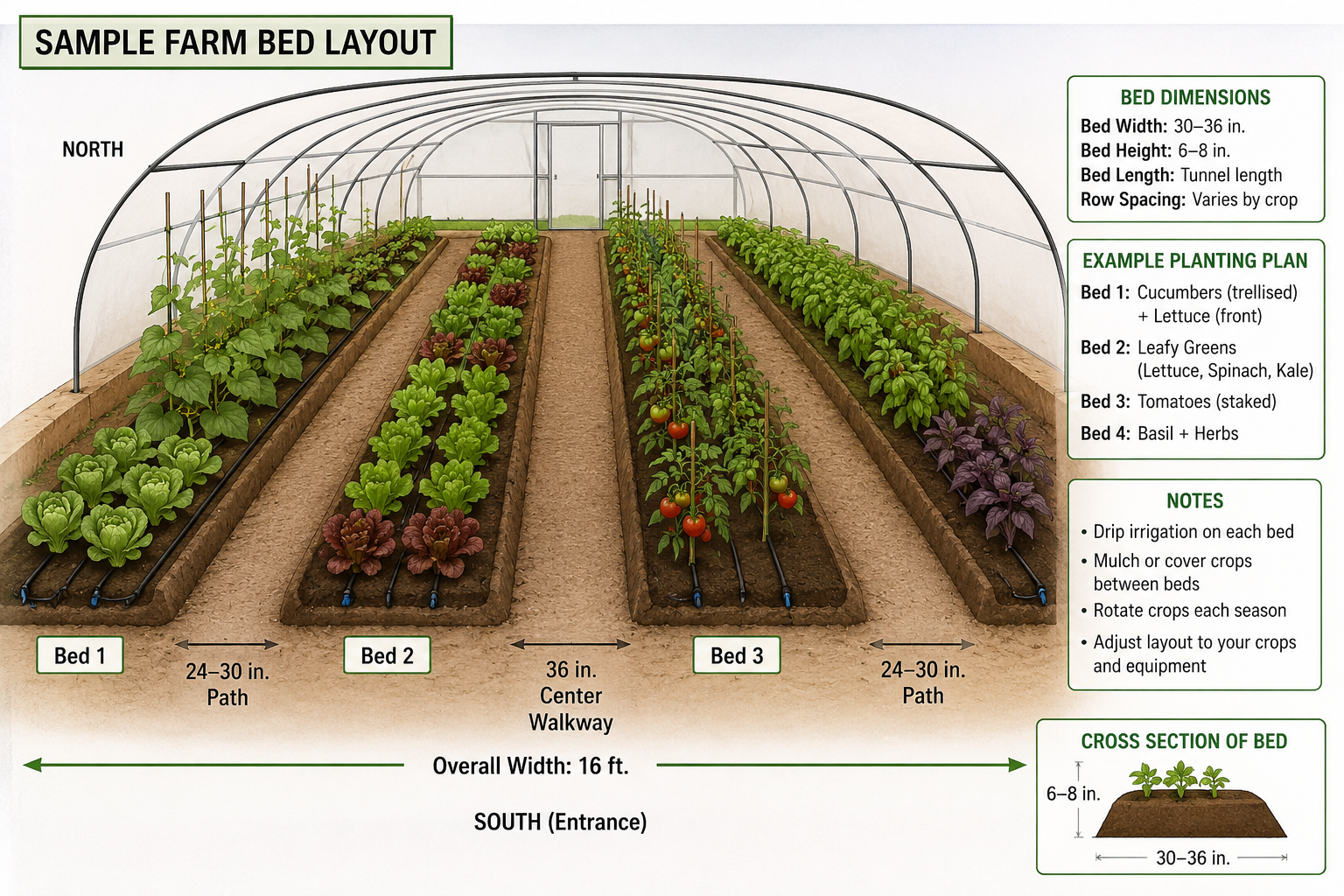
Example Four-Bed Rotation Plan
| Bed | Year 1 | Year 2 | Year 3 | Year 4 |
|---|---|---|---|---|
| Bed A | Beans & Peas | Lettuce & Spinach | Tomatoes & Peppers | Carrots & Onions |
| Bed B | Lettuce & Spinach | Tomatoes & Peppers | Carrots & Onions | Beans & Peas |
| Bed C | Tomatoes & Peppers | Carrots & Onions | Beans & Peas | Lettuce & Spinach |
| Bed D | Carrots & Onions | Beans & Peas | Lettuce & Spinach | Tomatoes & Peppers |
Key Principle
A successful crop rotation plan is intentional, diverse, and long-term. By rotating crop families, alternating nutrient demands, incorporating legumes and cover crops, and maintaining accurate records, farmers can build healthier soils, reduce pest and disease pressure, improve yields, and create a more resilient production system for vegetables, herbs, flowers, fruit, and berries.
Identifying, Monitoring, and Managing Crop Pests and Diseases
Successful crop production requires early identification, regular monitoring, and timely management of pests and diseases. The goal is not to eliminate every pest, but to keep populations below levels that cause significant economic damage. This approach is known as Integrated Pest Management (IPM) and combines prevention, monitoring, cultural practices, biological controls, and, when necessary, responsible pesticide use.
1. Identify Common Crop Pests
Farmers should learn to recognize common insect, mite, nematode, and vertebrate pests that affect their crops.
Common Insect Pests
| Pest | Crops Affected | Signs of Damage |
|---|---|---|
| Aphids | Vegetables, herbs, flowers, fruit | Curled leaves, sticky honeydew, stunted growth |
| Whiteflies | Tomatoes, peppers, herbs | Yellowing leaves, sticky residue |
| Caterpillars | Cabbage, lettuce, tomatoes | Holes in leaves and fruit |
| Cutworms | Seedlings | Plants cut off at soil level |
| Thrips | Onions, flowers, peppers | Silvery streaks, distorted leaves |
| Spider mites | Beans, strawberries, ornamentals | Yellow speckles, fine webbing |
| Beetles | Potatoes, beans, squash | Chewed leaves and stems |
2. Identify Common Plant Diseases
Fungal Diseases
- Powdery mildew
- Downy mildew
- Early blight
- Late blight
- Leaf spot
- Rust
- Root rot
Bacterial Diseases
- Bacterial wilt
- Bacterial leaf spot
- Soft rot
Viral Diseases
- Mosaic viruses
- Leaf curl viruses
- Tomato spotted wilt virus
3. Recognize Disease Symptoms
Watch for:
- Yellowing leaves
- Wilting
- Brown or black leaf spots
- Mold or mildew growth
- Stem cankers
- Root discoloration
- Poor fruit development
- Stunted growth
- Premature leaf drop
- Fruit rot
Early detection allows for faster and more effective management.
4. Scout and Monitor Crops Regularly
Regular field scouting is one of the most important pest management practices.
Monitoring Schedule
- Inspect crops at least once or twice each week.
- Increase inspections during warm, humid weather or when pest pressure is high.
- Check after heavy rain, storms, or prolonged heat.
What to Look For
- Insects on leaves and stems
- Eggs and larvae
- Chewed leaves
- Discolored foliage
- Wilting plants
- Mold or fungal growth
- Damaged fruit
- Weed infestations
Inspect both the upper and lower surfaces of leaves, where many pests hide.
5. Keep Monitoring Records
Record observations such as:
- Date
- Field or bed location
- Crop
- Pest or disease identified
- Severity
- Weather conditions
- Action taken
- Follow-up results
These records help identify recurring problems and improve future management decisions.
6. Prevent Pest and Disease Problems
Prevention is often the most effective and least expensive strategy.
Good Cultural Practices
- Rotate crops annually.
- Plant disease-resistant varieties.
- Use certified disease-free seeds and transplants.
- Maintain proper plant spacing for good airflow.
- Avoid overwatering.
- Remove infected plants promptly.
- Clean and disinfect tools and equipment.
- Control weeds that may harbor pests and diseases.
- Improve soil health with compost and cover crops.
7. Encourage Beneficial Organisms
Many beneficial insects naturally control pests.
Beneficial Insects
- Lady beetles (ladybugs)
- Lacewings
- Hoverflies
- Parasitic wasps
- Predatory mites
- Ground beetles
Encourage these insects by:
- Planting flowering species that provide nectar and pollen.
- Reducing unnecessary insecticide use.
- Maintaining habitat such as hedgerows and buffer strips.
8. Use Physical and Mechanical Controls
Examples include:
- Hand-picking insects
- Removing infected leaves or fruit
- Installing insect netting or row covers
- Using sticky traps
- Applying mulch to suppress weeds
- Pruning for better airflow
- Solarizing soil where appropriate
9. Biological Controls
Biological control uses natural enemies to reduce pest populations.
Examples:
- Beneficial nematodes for soil pests
- Bacillus thuringiensis (Bt) for caterpillars
- Predatory mites for spider mites
- Beneficial fungi for certain insect pests
10. Responsible Chemical Control
Chemical pesticides should be used only when monitoring indicates they are necessary and after considering other control methods.
Before Applying Pesticides
- Correctly identify the pest or disease.
- Select a product labeled for the specific crop and problem.
- Read and follow label directions.
- Wear appropriate personal protective equipment (PPE).
- Apply at the recommended rate and timing.
- Observe pre-harvest and re-entry intervals.
- Rotate pesticide modes of action to reduce resistance.
11. Integrated Pest Management (IPM)
An effective IPM program combines multiple management strategies.
| Step | Action |
|---|---|
| Prevention | Healthy soil, resistant varieties, sanitation |
| Monitoring | Regular scouting and recordkeeping |
| Identification | Correctly identify pests and diseases |
| Threshold | Determine if action is economically justified |
| Control | Use cultural, biological, mechanical, and chemical methods as needed |
| Evaluation | Review results and adjust future management practices |
12. Seasonal Pest Management
Spring
- Inspect seedlings for insects.
- Remove overwintered plant debris.
- Monitor for early disease symptoms.
Summer
- Scout frequently for insects and fungal diseases.
- Manage irrigation to reduce leaf wetness.
- Harvest mature crops promptly.
Fall
- Remove crop residues.
- Plant cover crops.
- Sanitize tools and equipment.
Winter
- Review monitoring records.
- Plan crop rotation.
- Order disease-resistant seed varieties.
Common Problems by Crop Type
| Crop | Common Pests | Common Diseases |
|---|---|---|
| Tomatoes | Aphids, hornworms, whiteflies | Early blight, late blight, bacterial spot |
| Lettuce | Aphids, slugs | Downy mildew, lettuce drop |
| Cucumbers | Cucumber beetles, aphids | Powdery mildew, downy mildew |
| Peppers | Aphids, thrips | Bacterial leaf spot, mosaic viruses |
| Strawberries | Spider mites, slugs | Gray mold, leaf spot |
| Fruit Trees | Scale insects, codling moths | Fire blight, apple scab, brown rot |
| Herbs | Aphids, spider mites | Powdery mildew, root rot |
| Flowers | Thrips, Japanese beetles | Botrytis, powdery mildew |
Best Practices
- Scout crops consistently and document findings.
- Correctly identify pests and diseases before taking action.
- Use resistant varieties whenever available.
- Rotate crops to interrupt pest and disease cycles.
- Promote healthy soil with compost and cover crops.
- Encourage beneficial insects through habitat management.
- Apply pesticides only when necessary and according to label instructions.
- Evaluate management results each season and refine your pest management plan.
Key Principle
Effective pest and disease management is based on prevention, early detection, and integrated control strategies. By combining good cultural practices, regular monitoring, biological and mechanical controls, and careful use of pesticides only when needed, farmers can protect vegetables, herbs, flowers, fruit, and berry crops while promoting long-term productivity, environmental stewardship, and sustainable farm management.
Developing a Basic Plan for Seeding, Planting, and Harvesting
A successful crop production system begins with a well-organized plan for seeding, planting, and harvesting. Proper planning ensures crops are planted at the right time, receive appropriate care throughout the growing season, and are harvested at peak quality to maximize yield and profitability.
1. Develop an Annual Crop Production Calendar
Prepare a calendar that outlines all major production activities.
Include:
- Soil preparation
- Compost application
- Seed ordering
- Greenhouse seed starting
- Direct seeding dates
- Transplanting dates
- Irrigation schedule
- Fertilizer applications
- Weed management
- Pest and disease monitoring
- Harvest dates
- Cover crop planting
A production calendar helps ensure that tasks are completed on time.
2. Plan Seed Selection
Choose high-quality seeds or planting material that are appropriate for your climate and market.
Consider:
- Disease-resistant varieties
- Days to maturity
- Yield potential
- Local climate adaptation
- Market demand
- Seed germination rate
- Certified or treated seed when appropriate
3. Prepare the Soil
Before planting:
- Conduct a soil test.
- Apply compost or organic matter.
- Correct soil pH if necessary.
- Incorporate recommended fertilizers.
- Remove weeds and crop residue.
- Prepare raised beds if needed.
- Install irrigation systems.
Healthy soil promotes strong seedling establishment.
4. Develop a Seeding Plan
Some crops are planted directly into the field, while others are started indoors or in a greenhouse and transplanted later.
Direct-Seeded Crops
- Beans
- Peas
- Carrots
- Radishes
- Spinach
- Beets
- Corn
Transplanted Crops
- Tomatoes
- Peppers
- Eggplant
- Broccoli
- Cabbage
- Cauliflower
- Lettuce (often)
- Herbs such as basil
5. Determine Planting Dates
Plant according to:
- Frost dates
- Soil temperature
- Crop requirements
- Rainfall patterns
- Market timing
Succession planting—sowing small amounts every 1–3 weeks for certain crops—can provide a continuous harvest throughout the season.
6. Establish Proper Spacing
Correct spacing improves:
- Air circulation
- Root development
- Sunlight penetration
- Disease prevention
- Harvest efficiency
Follow recommended spacing guidelines for each crop.
7. Irrigation After Planting
Newly planted seeds and transplants require consistent moisture.
Best practices:
- Water immediately after planting.
- Keep seedbeds evenly moist until germination.
- Use drip irrigation where possible.
- Avoid overwatering to reduce disease risk.
8. Crop Monitoring During Growth
Monitor crops regularly for:
- Germination success
- Plant population
- Weed pressure
- Pest activity
- Disease symptoms
- Nutrient deficiencies
- Irrigation needs
Record observations and take corrective action when necessary.
9. Develop a Harvest Plan
Harvest crops at the proper stage of maturity to maximize quality, flavor, shelf life, and market value.
Consider:
- Expected harvest dates
- Labor requirements
- Harvest tools
- Packaging materials
- Transportation
- Storage facilities
- Market delivery schedules
10. Harvesting Guidelines by Crop
| Crop | Harvest Stage |
|---|---|
| Tomatoes | Fully colored but firm |
| Lettuce | Full-sized heads before bolting |
| Carrots | Desired root size |
| Cucumbers | Young and firm |
| Peppers | Mature green or fully colored |
| Beans | Tender pods |
| Herbs | Before flowering for best flavor |
| Strawberries | Fully red and ripe |
| Apples | Mature color and firmness |
| Blueberries | Fully blue and easily detached |
11. Post-Harvest Handling
Immediately after harvest:
- Remove damaged produce.
- Wash (when appropriate).
- Grade by size and quality.
- Cool produce quickly if required.
- Package carefully.
- Store at recommended temperatures.
- Transport promptly to market.
Proper handling helps reduce post-harvest losses and maintains product quality.
Sample Seasonal Production Schedule
| Activity | Spring | Summer | Fall | Winter |
|---|---|---|---|---|
| Soil Testing | ✓ | |||
| Compost Application | ✓ | ✓ | ||
| Seed Starting | ✓ | |||
| Direct Seeding | ✓ | ✓ | ||
| Transplanting | ✓ | ✓ | ||
| Irrigation | ✓ | ✓ | ✓ | |
| Weed Control | ✓ | ✓ | ✓ | |
| Pest Monitoring | ✓ | ✓ | ✓ | |
| Harvesting | ✓ | ✓ | ||
| Cover Crop Planting | ✓ | |||
| Equipment Maintenance | ✓ | ✓ |
Example Crop Production Plan
| Crop | Seed Indoors | Transplant/Direct Seed | Expected Harvest |
|---|---|---|---|
| Tomatoes | 6–8 weeks before last frost | Transplant after frost | 70–90 days after transplant |
| Lettuce | Optional | Direct seed or transplant | 30–60 days |
| Carrots | Not required | Direct seed | 60–80 days |
| Cucumbers | 3–4 weeks before planting (optional) | Direct seed or transplant | 50–70 days |
| Basil | 4–6 weeks before planting | Transplant after frost | 60–90 days |
| Strawberries | Purchase crowns or plants | Plant in early spring or fall | Harvest the following season (June-bearing) or continuously (day-neutral/everbearing varieties) |
Best Practices
- Develop a written production calendar before the growing season begins.
- Select crop varieties suited to your climate, soil, and target market.
- Use quality seeds and healthy transplants.
- Prepare fertile, well-drained soil with compost and appropriate nutrients.
- Plant at the correct time, depth, and spacing.
- Monitor crops regularly and keep detailed production records.
- Harvest at peak maturity and handle produce carefully to preserve quality.
- Evaluate yields and production results after each season to improve future planning.
Key Principle
A well-organized seeding, planting, and harvesting plan helps ensure healthy crop establishment, efficient use of labor and resources, consistent production, and high-quality harvests. Careful scheduling, good soil preparation, timely planting, regular crop monitoring, and proper post-harvest handling are essential for successful production of vegetables, herbs, flowers, fruit, and berries.
Developing a Post-Harvest Handling Strategy to Maximize Produce Safety and Quality
Post-harvest handling includes all activities that occur after crops are harvested until they reach the consumer. Proper post-harvest management helps maintain freshness, reduce spoilage, ensure food safety, extend shelf life, and preserve the market value of vegetables, herbs, flowers, fruit, and berries.
Objectives of a Post-Harvest Handling Strategy
The primary goals are to:
- Maintain product freshness and appearance
- Prevent contamination
- Minimize bruising and physical damage
- Extend shelf life
- Reduce post-harvest losses
- Deliver high-quality produce to customers
- Comply with food safety standards
1. Harvest at the Proper Stage of Maturity
Harvest crops when they have reached the ideal stage for their intended market.
Examples:
| Crop | Recommended Harvest Stage |
|---|---|
| Tomatoes | Fully colored but still firm |
| Cucumbers | Young, tender, and firm |
| Lettuce | Full-sized heads before bolting |
| Carrots | Mature root size with smooth texture |
| Herbs | Before flowering for best flavor and aroma |
| Strawberries | Fully red and ripe |
| Apples | Mature color, sugar content, and firmness |
| Blueberries | Fully blue and easily detached |
| Cut Flowers | Bud stage or partially open, depending on species |
Harvesting too early reduces flavor and quality, while harvesting too late shortens shelf life.
2. Harvest Carefully
Reduce mechanical damage during harvest.
Best Practices
- Harvest during the coolest part of the day (early morning or evening).
- Use clean, sharp harvesting tools.
- Wear clean gloves when appropriate.
- Avoid dropping or throwing produce.
- Do not overfill harvest containers.
- Protect harvested produce from direct sunlight.
3. Maintain Good Hygiene
Food safety begins with clean harvesting practices.
Worker Hygiene
- Wash hands before handling produce.
- Wear clean clothing.
- Cover cuts or wounds.
- Stay home when ill.
- Use clean harvesting containers.
Equipment Hygiene
- Clean knives, pruners, and harvesting tools daily.
- Sanitize wash tanks and packing equipment.
- Clean storage bins and transport containers regularly.
4. Remove Field Heat Quickly
Freshly harvested produce continues to respire. Removing field heat slows deterioration and extends shelf life.
Cooling Methods
- Forced-air cooling
- Hydrocooling
- Vacuum cooling (leafy vegetables)
- Ice cooling (where appropriate)
- Refrigerated storage
Prompt cooling helps preserve freshness and quality.
5. Wash Produce Safely
Not all produce requires washing, but when washing is appropriate:
- Use potable (safe drinking) water.
- Change wash water regularly.
- Prevent cross-contamination.
- Allow produce to drain and dry before packaging.
Some crops, such as berries, are often packed without washing to reduce moisture and spoilage.
6. Sort and Grade Produce
Separate produce according to:
- Size
- Color
- Ripeness
- Quality
- Damage
- Disease symptoms
Remove produce that is:
- Bruised
- Rotten
- Diseased
- Insect-damaged
- Overripe
Uniform grading improves customer satisfaction and market value.
7. Package Properly
Packaging should protect produce while allowing adequate ventilation.
Good Packaging Materials
- Food-grade plastic crates
- Cardboard cartons
- Ventilated boxes
- Berry clamshell containers
- Mesh bags (for onions and garlic)
- Flower sleeves and buckets (for cut flowers)
Avoid overpacking, which can crush produce.
8. Store at Appropriate Temperature and Humidity
Different crops require different storage conditions.
| Crop | Recommended Storage Conditions |
|---|---|
| Leafy Greens | 32–36°F (0–2°C), high humidity |
| Carrots | 32–34°F (0–1°C), high humidity |
| Apples | 32–36°F (0–2°C), high humidity |
| Strawberries | 32°F (0°C), high humidity |
| Herbs | 34–41°F (1–5°C), moderate to high humidity |
| Tomatoes | 55–70°F (13–21°C); avoid refrigeration for ripe fruit if quality is a priority |
| Onions | Cool, dry, well-ventilated storage |
| Garlic | Cool, dry, well-ventilated storage |
Monitor storage temperature and humidity regularly.
9. Prevent Cross-Contamination
Store produce away from:
- Chemicals
- Fuel
- Fertilizers
- Livestock
- Waste materials
- Dirty equipment
Separate damaged produce from market-ready produce.
10. Transport Carefully
During transportation:
- Use clean vehicles.
- Secure containers to prevent shifting.
- Protect produce from heat and direct sunlight.
- Maintain refrigeration when required.
- Deliver produce as quickly as possible.
11. Maintain Traceability
Keep records of:
- Harvest date
- Field or block number
- Crop variety
- Lot or batch number
- Packing date
- Destination
- Quantity harvested
Traceability supports food safety, quality control, and product recalls if necessary.
12. Reduce Post-Harvest Losses
Common causes of losses include:
- Bruising
- Improper temperature management
- Poor sanitation
- Delayed cooling
- Inadequate packaging
- Pest infestation
- Excess moisture
- Improper storage
A proactive handling system minimizes these risks.
Sample Post-Harvest Workflow
- Harvest at peak maturity.
- Place produce in clean harvest containers.
- Move produce promptly to a shaded or cooled area.
- Remove field heat using an appropriate cooling method.
- Wash (if appropriate) with potable water.
- Sort and grade produce.
- Package in suitable containers.
- Store under recommended conditions.
- Transport using clean, temperature-controlled vehicles when needed.
- Deliver promptly to customers or markets.
Crop-Specific Considerations
| Crop Type | Key Post-Harvest Practices |
|---|---|
| Vegetables | Rapid cooling, washing when appropriate, grading, refrigerated storage |
| Herbs | Gentle handling, bunching, hydration, cool storage |
| Flowers | Immediate hydration, clean buckets, cool chain maintenance |
| Fruit | Careful picking, grading, controlled-temperature storage |
| Berries | Minimal handling, rapid cooling, shallow packaging, avoid unnecessary washing |
Best Practices
- Harvest during cool parts of the day.
- Train workers in proper hygiene and safe handling.
- Use clean tools, containers, and equipment.
- Remove field heat as quickly as possible.
- Sort and package produce carefully to reduce damage.
- Store each crop at its recommended temperature and humidity.
- Maintain accurate harvest and traceability records.
- Transport produce promptly under suitable conditions.
- Regularly inspect stored produce and remove any spoiled items to prevent spread.
Key Principle
A successful post-harvest handling strategy protects both food safety and product quality from the moment crops are harvested until they reach the consumer. By combining proper harvest timing, careful handling, sanitation, rapid cooling, appropriate storage, and efficient transportation, farmers can reduce waste, extend shelf life, increase customer satisfaction, and improve the profitability of vegetables, herbs, flowers, fruit, and berry enterprises.
Records to Keep for Sound Decision-Making in Future Crop Enterprises
Good recordkeeping is one of the most valuable management tools on a farm. Accurate records help evaluate crop performance, control costs, improve productivity, comply with food safety requirements, and make informed decisions about future planting, investments, and marketing strategies.
Why Keep Farm Records?
Farm records help you:
- Measure profitability
- Compare crop performance
- Improve production efficiency
- Plan future planting schedules
- Identify pest and disease trends
- Monitor soil fertility
- Meet food safety and certification requirements
- Prepare financial reports and tax records
- Support loan or grant applications
1. Crop Production Records
Document all production activities for each crop.
Record:
- Crop name and variety
- Field or bed number
- Planting date
- Seed source
- Seed lot number (if available)
- Germination rate
- Transplant date
- Harvest date
- Days to maturity
Purpose: Evaluate crop performance and improve future planting schedules.
2. Field and Crop Rotation Records
Keep a history of crops grown in each field.
Record:
- Field identification
- Crop family
- Previous crops
- Cover crops planted
- Rotation schedule
- Soil amendments applied
Purpose: Reduce pest and disease problems and maintain soil fertility.
3. Soil Fertility Records
Track soil health and nutrient management.
Record:
- Soil test results
- Soil pH
- Organic matter content
- Fertilizer applications
- Compost applications
- Lime applications
- Cover crop history
Purpose: Guide fertilizer decisions and improve long-term soil health.
4. Irrigation Records
Monitor water use and irrigation efficiency.
Record:
- Irrigation dates
- Amount of water applied
- Irrigation method
- Rainfall
- Soil moisture observations
Purpose: Improve water management and reduce waste.
5. Pest and Disease Records
Monitor crop health throughout the season.
Record:
- Pest or disease identified
- Field location
- Date observed
- Severity
- Weather conditions
- Treatment applied
- Results of treatment
Purpose: Identify recurring problems and improve pest management strategies.
6. Chemical and Fertilizer Application Records
Maintain accurate application records.
Record:
- Product name
- Active ingredient
- Application rate
- Application date
- Crop treated
- Field location
- Applicator name
- Weather conditions
Purpose: Ensure regulatory compliance, food safety, and effective crop management.
7. Labor Records
Track labor requirements for each crop.
Record:
- Employee name
- Task performed
- Hours worked
- Wage rate
- Date
Purpose: Calculate labor costs and improve workforce planning.
8. Equipment Records
Track equipment use and maintenance.
Record:
- Equipment used
- Hours of operation
- Fuel consumption
- Maintenance performed
- Repair costs
- Breakdown history
Purpose: Plan maintenance and evaluate equipment efficiency.
9. Harvest Records
Track production and crop quality.
Record:
- Harvest date
- Crop harvested
- Quantity harvested
- Grade or quality
- Field harvested
- Labor used
Purpose: Measure productivity and compare varieties or fields.
10. Sales and Marketing Records
Monitor product sales and customer demand.
Record:
- Product sold
- Quantity
- Selling price
- Customer
- Market outlet
- Sales date
- Transportation costs
Purpose: Evaluate market performance and identify profitable crops.
11. Financial Records
Track farm income and expenses.
Record:
- Seed purchases
- Fertilizer costs
- Fuel expenses
- Labor costs
- Equipment expenses
- Utilities
- Packaging costs
- Transportation
- Total income
Purpose: Determine profitability and prepare financial statements.
12. Weather Records
Keep a record of weather conditions during the growing season.
Record:
- Temperature
- Rainfall
- Frost dates
- Wind events
- Heat waves
- Drought periods
Purpose: Understand how weather affects crop performance and plan future planting dates.
13. Food Safety and Traceability Records
Essential for many commercial farms.
Record:
- Harvest dates
- Lot numbers
- Packing dates
- Storage temperatures
- Cleaning schedules
- Worker hygiene training
- Product destinations
Purpose: Meet food safety standards and enable product traceability.
14. Inventory Records
Track farm supplies and harvested products.
Record:
- Seeds
- Fertilizers
- Chemicals
- Packaging materials
- Harvest containers
- Produce in storage
Purpose: Prevent shortages and reduce unnecessary purchases.
Example Farm Record System
| Record Type | Information to Track | Purpose |
|---|---|---|
| Crop Production | Variety, planting, harvest | Improve production planning |
| Soil | Soil tests, compost, fertilizer | Maintain fertility |
| Irrigation | Water use, rainfall | Improve water efficiency |
| Pest & Disease | Pest observations, treatments | Improve crop protection |
| Equipment | Maintenance, repairs | Reduce downtime |
| Labor | Hours, wages | Calculate labor costs |
| Harvest | Quantity, quality | Measure yields |
| Sales | Price, customer | Evaluate profitability |
| Financial | Expenses, income | Business planning |
| Weather | Rainfall, temperature | Production planning |
Digital Recordkeeping Tools
Farm records can be kept using:
- Spreadsheets (Microsoft Excel or Google Sheets)
- Farm management software
- Mobile farm recordkeeping apps
- Accounting software
- Paper logbooks and field notebooks
Choose a system that is simple, organized, and updated consistently.
Best Practices
- Record information as soon as activities are completed.
- Use consistent field names and crop codes.
- Back up digital records regularly.
- Keep receipts and invoices organized.
- Review records at the end of each growing season.
- Compare yields, costs, and profits across crops and fields.
- Use records to improve crop rotation, budgeting, and marketing decisions.
- Retain records for several years to identify long-term trends.
Key Performance Indicators (KPIs) to Monitor
| KPI | Why It Matters |
|---|---|
| Yield per acre (or hectare) | Measures productivity |
| Germination percentage | Evaluates seed quality and planting success |
| Crop loss percentage | Identifies production problems |
| Water use efficiency | Improves irrigation management |
| Fertilizer cost per acre | Controls input costs |
| Labor hours per acre | Measures labor efficiency |
| Revenue per acre | Compares crop profitability |
| Net profit by crop | Identifies the most profitable enterprises |
Key Principle
Effective recordkeeping turns day-to-day farming activities into valuable management information. By maintaining accurate records on production, soil health, pest management, labor, equipment, harvests, sales, finances, and weather, farmers can evaluate performance, reduce costs, improve yields, meet regulatory requirements, and make informed decisions about which vegetable, herb, flower, fruit, and berry enterprises to expand, modify, or discontinue in future growing seasons.
Evaluating Land and Facilities for Farming
Matching Land to Your Farming Goals
Choosing the right land is one of the most important decisions when starting or expanding a farm. The land, facilities, and natural resources should support your production goals, budget, and long-term business plan. Not every property is suitable for every type of farming, so it is essential to evaluate whether a piece of land matches the enterprise you intend to operate.
Define Your Farming Goals
Before purchasing or leasing land, clearly identify your objectives.
Examples include:
- Growing vegetables
- Producing herbs
- Flower farming
- Fruit orchards
- Berry production
- Livestock grazing
- Mixed farming
- Organic farming
- Agritourism
- Greenhouse production
Your farming goals determine the type and quality of land and facilities you will need.
Evaluate the Land
Size
Consider whether the property provides enough space for:
- Current production
- Future expansion
- Equipment movement
- Storage buildings
- Greenhouses
- Livestock facilities
- Access roads
- Buffer zones
Example
| Enterprise | Typical Land Requirement |
|---|---|
| Market Garden | 1–5 acres |
| Vegetable Farm | 5–50 acres |
| Berry Farm | 2–20 acres |
| Orchard | 10–100+ acres |
| Mixed Farm | 20–200+ acres |
Soil Quality
Healthy soil is essential for productive farming.
Evaluate:
- Soil texture (sand, loam, clay)
- Soil depth
- Drainage
- Organic matter
- Soil pH
- Fertility
- Compaction
- Erosion risk
Always perform a soil test before purchasing or leasing land.
Water Availability
Reliable water is critical.
Determine:
- Availability throughout the year
- Water quality
- Existing wells or boreholes
- Surface water access
- Irrigation potential
- Water rights (where applicable)
Topography
Slope affects farming operations.
Flat Land
Suitable for:
- Vegetables
- Mechanized farming
- Greenhouses
Gentle Slopes
Suitable for:
- Orchards
- Vineyards
- Pastures
Steep Slopes
Better suited for:
- Forestry
- Grazing
- Permanent crops with erosion control
Climate
Evaluate:
- Growing season length
- Average rainfall
- Frost dates
- Heat stress
- Wind exposure
- Humidity
- Drought frequency
Choose crops that are well adapted to local conditions.
Sunlight
Most crops require at least 6–8 hours of direct sunlight per day.
Check for:
- Trees casting shade
- Buildings blocking sunlight
- Hills that reduce sun exposure
Existing Infrastructure
Evaluate the condition of:
- Barns
- Equipment sheds
- Greenhouses
- Packing facilities
- Cold storage
- Irrigation systems
- Farm roads
- Fencing
- Electrical service
- Water systems
Estimate repair or replacement costs before making a purchase.
Accessibility
Good access reduces transportation costs.
Consider:
- Road quality
- Distance to highways
- Access for trucks
- Loading areas
- Parking
- Year-round accessibility
Market Access
Evaluate proximity to:
- Farmers markets
- Grocery stores
- Restaurants
- Food distributors
- Processing facilities
- Wholesale buyers
Being closer to customers can reduce transportation costs and preserve product quality.
Labor Availability
Determine whether skilled labor is available nearby.
Consider:
- Seasonal workers
- Permanent employees
- Housing availability
- Local wage rates
Environmental Considerations
Identify:
- Flood-prone areas
- Wetlands
- Protected habitats
- Drainage patterns
- Wildlife pressure
- Soil erosion risks
Utilities
Verify access to:
- Electricity
- Internet
- Telephone service
- Natural gas (if needed)
- Fuel delivery
- Waste disposal
Future Expansion
Select land that allows for growth.
Examples:
- Additional fields
- More greenhouses
- Packing facilities
- Cold storage
- Livestock buildings
- Agritourism activities
Match Land to Enterprise
| Enterprise | Ideal Land Characteristics |
|---|---|
| Vegetables | Fertile, level, well-drained soil with irrigation |
| Herbs | Well-drained soil, full sun, good road access |
| Flowers | Fertile soil, irrigation, packing space, cold storage |
| Fruit Orchards | Deep, well-drained soil, good air drainage, frost protection |
| Berry Crops | Slightly acidic, well-drained soil with reliable irrigation |
| Livestock | Adequate pasture, fencing, dependable water supply |
| Greenhouse Production | Flat land with utilities and year-round road access |
Facility Evaluation Checklist
Buildings
- □ Barns in good condition
- □ Equipment storage
- □ Workshop
- □ Packing area
- □ Cold storage
- □ Office space
Utilities
- □ Reliable water supply
- □ Electricity
- □ Internet access
- □ Irrigation system
Safety
- □ Secure fencing
- □ Safe chemical storage
- □ Fire extinguishers
- □ Emergency access
Questions to Ask Before Buying or Leasing
- Does this property support my farming goals?
- Is the soil suitable for my intended crops?
- Is there enough reliable water?
- Are existing buildings usable or do they require major repairs?
- Can farm equipment operate efficiently on the land?
- Is the property accessible throughout the year?
- Are there environmental or zoning restrictions?
- Is there enough room to expand?
- Are nearby markets available for selling products?
- Does the property’s total cost fit within my business budget?
Best Practices
- Match the land to your enterprise rather than trying to force unsuitable land into a production system.
- Conduct professional soil and water testing before committing to a property.
- Inspect all buildings and infrastructure carefully and estimate repair costs.
- Evaluate access to markets, suppliers, and labor.
- Consider both immediate operational needs and long-term expansion plans.
- Prepare a written land evaluation checklist and compare multiple properties before making a decision.
Key Principle
The best farmland is not necessarily the largest or the least expensive—it is the land that best supports your farming objectives. By evaluating soil, water, climate, topography, infrastructure, accessibility, and future expansion potential, you can choose land and facilities that provide the strongest foundation for a productive, profitable, and sustainable farming enterprise.
Land Access Strategies and Support
Access to farmland is one of the biggest challenges for new and expanding farmers. Purchasing land is not the only option. There are several strategies for gaining access to farmland, each with its own advantages, costs, and level of commitment. Understanding these options and the support available can help farmers choose the approach that best fits their goals and financial situation.
1. Purchasing Farmland
Buying land provides long-term security and allows the farmer to build equity.
Advantages
- Full control over land use and improvements
- Long-term investment and asset appreciation
- Greater ability to secure financing
- Freedom to develop infrastructure
- Can be passed on to future generations
Challenges
- High upfront cost
- Property taxes
- Loan repayments
- Maintenance responsibilities
- Less flexibility if business plans change
Best For
- Farmers with long-term production goals
- Established farming businesses
- Multi-generation family farms
2. Leasing Farmland
Leasing allows farmers to use land without purchasing it.
Types of Leases
Cash Lease
The farmer pays a fixed rental amount.
Advantages
- Predictable annual costs
- Simple agreement
- Farmer keeps all production income
Crop Share Lease
The landowner receives a percentage of the crop or farm income instead of fixed rent.
Advantages
- Lower cash requirement
- Shared production risk
- Suitable for beginning farmers
Flexible Lease
Rent varies based on crop yields, market prices, or other agreed factors.
Benefits of Leasing
- Lower startup costs
- Easier entry into farming
- Greater flexibility
- Opportunity to test a farming business before purchasing land
Challenges
- Limited long-term security
- Restrictions on improvements
- Lease renewal uncertainty
3. Renting Land Seasonally
Some landowners rent fields for a single growing season.
Suitable For
- Vegetable production
- Hay production
- Flower farming
- Specialty crops
This option offers flexibility but requires careful planning because access may not continue beyond the agreed period.
4. Farm Partnerships
Two or more individuals share land, labor, equipment, or capital.
Benefits
- Shared investment
- Shared equipment
- Reduced financial risk
- Combined expertise
- Increased production capacity
Considerations
- Clearly define responsibilities.
- Prepare a written partnership agreement.
- Establish decision-making procedures.
5. Family Land
Many farmers begin by using land owned by family members.
Advantages
- Lower acquisition costs
- Existing infrastructure may already be available
- Easier transition into farming
Best Practice
Prepare written agreements covering:
- Land use
- Responsibilities
- Improvements
- Succession planning
- Duration of use
6. Community Gardens and Urban Farms
Small-scale growers can begin farming using:
- Community gardens
- Municipal land
- School gardens
- Church property
- Non-profit organizations
These opportunities allow farmers to gain experience before expanding to larger operations.
7. Cooperative Farming
Several farmers jointly manage or share:
- Land
- Equipment
- Storage
- Marketing
- Transportation
Benefits include lower costs and greater efficiency.
8. Government and Public Land Programs
Some governments offer:
- Long-term agricultural leases
- Beginning farmer land programs
- Public land leases for grazing
- Farm settlement programs
- Agricultural development projects
Eligibility requirements vary by location.
9. Land Trusts and Conservation Organizations
Agricultural land trusts work to preserve farmland by:
- Purchasing development rights
- Leasing farmland to farmers
- Assisting with affordable land access
- Protecting farmland from non-agricultural development
These programs can make farmland more affordable while ensuring it remains in agricultural use.
10. Incubator Farms
Incubator farms provide beginning farmers with:
- Small plots of land
- Equipment access
- Irrigation
- Training
- Mentoring
- Business support
Farmers gain practical experience before investing in larger operations.
Support Services for Farmers
Many organizations provide technical and financial assistance.
Agricultural Extension Services
They offer:
- Production advice
- Soil testing
- Pest management
- Business planning
- Marketing assistance
- Educational workshops
Government Agriculture Agencies
Support may include:
- Cost-share programs
- Conservation incentives
- Farm loans
- Disaster assistance
- Beginning farmer programs
- Risk management education
Financial Institutions
Potential financing options:
- Agricultural loans
- Equipment financing
- Operating loans
- Farm mortgages
- Lines of credit
Conservation Programs
Support may be available for:
- Cover crops
- Irrigation improvements
- Soil conservation
- Wildlife habitat
- Water management
- Tree planting
Producer Organizations
Membership often provides:
- Training
- Market information
- Bulk purchasing
- Networking
- Advocacy
- Educational resources
Comparing Land Access Options
| Option | Initial Cost | Long-Term Security | Flexibility | Best For |
|---|---|---|---|---|
| Purchase | High | Excellent | Low | Established farms |
| Cash Lease | Low–Medium | Moderate | Good | Most beginning farmers |
| Crop Share Lease | Low | Moderate | Good | Farmers with limited capital |
| Seasonal Rental | Low | Low | Excellent | Short-term or specialty crops |
| Partnership | Shared | Moderate | Moderate | Collaborative operations |
| Family Land | Low | Varies | Good | Family farms |
| Community Garden | Very Low | Low | Excellent | New growers |
| Incubator Farm | Very Low | Temporary | Excellent | Beginning farmers |
Questions to Consider Before Choosing a Land Access Strategy
- What is my available budget?
- How much land do I need now and in five years?
- Do I want long-term ownership or short-term flexibility?
- Will I need to build permanent infrastructure?
- Does the agreement allow improvements such as irrigation or fencing?
- What are the responsibilities for taxes, maintenance, and repairs?
- Are there restrictions on crops or farming practices?
- Is the property close to markets, suppliers, and labor?
Best Practices
- Compare several land access options before making a commitment.
- Carefully inspect the land, buildings, water supply, and soil before signing an agreement.
- Use written lease or partnership agreements that clearly define responsibilities.
- Build relationships with agricultural advisors, extension agents, lenders, and experienced farmers.
- Take advantage of training, conservation programs, and financial assistance available to beginning farmers.
- Select a land access strategy that supports both your current production needs and your long-term business goals.
Key Principle
Successful farming begins with securing land that matches your enterprise and financial resources. Whether you purchase, lease, share, or temporarily rent farmland, choosing the right land access strategy—and making use of available technical, financial, and educational support—can reduce startup risks, improve profitability, and create a strong foundation for long-term success.
How Much Land is Enough?
The amount of land needed for a successful farm depends on what you plan to produce, your farming methods, available resources, market demand, and long-term business goals. More land does not always mean greater profitability. Many small farms are highly productive because they use intensive production methods and focus on high-value crops.
Factors That Determine How Much Land You Need
Before acquiring land, consider:
- Type of farming enterprise
- Number of crops or livestock
- Production methods (traditional or intensive)
- Available labor
- Equipment size
- Water availability
- Soil quality
- Market demand
- Future expansion plans
- Budget
Typical Land Requirements by Enterprise
| Farming Enterprise | Typical Land Needed |
|---|---|
| Home Garden | 500–5,000 sq. ft. |
| Market Garden | 0.25–5 acres |
| Vegetable Farm | 5–50 acres |
| Herb Farm | 0.5–10 acres |
| Cut Flower Farm | 0.5–10 acres |
| Berry Farm | 2–20 acres |
| Orchard | 10–100+ acres |
| Greenhouse Production | Less than 1 acre (plus support area) |
| Mixed Crop Farm | 10–100 acres |
| Small Livestock Farm | 5–50 acres (depending on species and grazing needs) |
These are general guidelines. Actual land needs vary by location, climate, and management practices.
Land Requirements for Vegetable Production
Vegetable farms can be productive on relatively small areas.
Small Market Garden
- 0.25–1 acre
- Direct sales through farmers’ markets or Community Supported Agriculture (CSA)
- Intensive planting methods
Commercial Vegetable Farm
- 5–50 acres
- Mechanized production
- Wholesale and retail markets
Land Requirements for Fruit and Berry Production
Berry Crops
- 2–10 acres can support profitable production.
- Require irrigation, careful management, and regular harvesting.
Orchards
- Usually require 10 or more acres for commercial-scale production.
- Long-term investment with several years before full production.
Land Requirements for Herbs and Flowers
Many herbs and flowers are high-value crops.
A well-managed 1–5 acre farm can produce:
- Culinary herbs
- Medicinal herbs
- Lavender
- Cut flowers
- Specialty flowers for florists and events
Intensive Farming Can Reduce Land Requirements
Modern production methods increase productivity on smaller properties.
Examples include:
- Raised beds
- High tunnels
- Greenhouses
- Drip irrigation
- Mulching
- Vertical growing systems
- Succession planting
- Season extension techniques
These methods can significantly increase production per acre.
Consider Space Beyond Crop Production
In addition to growing areas, allow space for:
- Equipment storage
- Barns and sheds
- Greenhouses
- Packing and washing areas
- Cold storage
- Composting
- Access roads
- Parking
- Water storage
- Buffer zones
- Windbreaks
Plan for Future Expansion
Avoid selecting land that only meets your immediate needs.
Ask yourself:
- Will I add more crops?
- Will I build additional greenhouses?
- Will I need more storage?
- Will I hire employees?
- Will I diversify into livestock or agritourism?
Planning ahead can reduce future relocation or expansion costs.
Consider Labor Availability
The amount of land you can manage depends on available labor.
Examples:
- One person can manage a small market garden with intensive production.
- Larger farms often require seasonal workers, especially during planting and harvest.
- Mechanization can reduce labor needs but increases equipment costs.
Consider Equipment
Equipment size should match the farm size.
Examples:
| Farm Size | Typical Equipment |
|---|---|
| Under 5 acres | Hand tools, walk-behind tractors, small utility vehicles |
| 5–25 acres | Compact tractors, implements, irrigation systems |
| 25+ acres | Full-size tractors, larger implements, harvest equipment |
Using oversized equipment on a small farm can increase costs unnecessarily.
Water Availability Matters
Even large areas of fertile land may not be suitable if there is an inadequate water supply.
Evaluate:
- Irrigation capacity
- Well or borehole yield
- Surface water availability
- Rainfall reliability
- Water storage systems
Sample Land Planning Example
| Farm Feature | Area Needed |
|---|---|
| Vegetable Production | 3 acres |
| Berry Production | 1 acre |
| Greenhouse | 0.25 acre |
| Packing Shed | 0.25 acre |
| Equipment Storage | 0.25 acre |
| Access Roads | 0.5 acre |
| Buffer Zones | 0.5 acre |
| Future Expansion | 2.25 acres |
| Total Property Size | 8 acres |
Questions to Ask Before Choosing Farm Size
- What crops or livestock will I produce?
- How much can I realistically manage?
- Is there enough water for future production?
- Will the property allow expansion?
- Can I afford to maintain all of the land?
- Do I have enough labor and equipment?
- Will the land generate enough income to support my business goals?
Best Practices
- Choose land based on your production goals rather than simply purchasing the largest property available.
- Start with a manageable acreage and expand as your business grows.
- Consider total usable land, not just total acreage.
- Leave room for infrastructure, storage, and future development.
- Match land size with available labor, equipment, water, and financial resources.
- Develop a written farm layout and business plan before acquiring land.
Common Mistakes to Avoid
- Buying more land than you can manage or afford.
- Ignoring soil quality and water availability.
- Underestimating the space needed for buildings and equipment.
- Failing to plan for future growth.
- Choosing land without considering market access or transportation.
Key Principle
The right amount of land is the amount that enables you to operate efficiently, profitably, and sustainably. By matching your land size to your farming goals, production methods, available resources, and future plans, you can build a farm that is both productive today and capable of growing with your business over time.
Online Farmland Directories
Online farmland directories are websites and platforms that connect farmers, landowners, buyers, sellers, and tenants. These resources help farmers locate farmland for sale or lease, advertise land, find partnership opportunities, and access beginning farmer programs. They can save time, broaden your search area, and make it easier to compare available properties.
Benefits of Using Online Farmland Directories
Online directories can help you:
- Find farmland for sale or lease
- Connect directly with landowners
- Compare property prices and acreage
- Search by location, soil type, or land use
- Discover beginning farmer opportunities
- Explore farm partnerships and succession opportunities
- Access educational resources and support programs
Types of Online Farmland Directories
1. Farmland Marketplace Websites
These platforms specialize in farmland listings.
Typical features include:
- Farms for sale
- Farms for lease
- Ranches
- Orchards
- Recreational land
- Interactive maps
- Property photos
- Price comparisons
Examples include:
These websites allow users to filter listings by state, county, acreage, price, and land type.
2. Farm Link Programs
Farm Link programs connect retiring farmers and landowners with beginning farmers looking for land.
These programs often include:
- Land matching
- Farm succession planning
- Leasing opportunities
- Mentorship
- Beginning farmer support
Examples include:
Many of these services are free and are designed to help preserve farmland while assisting new farmers in finding opportunities.
3. Government Resources
Government agencies often maintain directories or provide links to farmland resources.
These may include:
- Beginning farmer programs
- USDA inventory properties
- Agricultural land programs
- Conservation programs
- Farm loan information
State and federal beginning farmer guides often list trusted land-access resources and directories.
4. Agricultural Organizations
Many agricultural organizations maintain farmland databases and educational resources.
They may offer:
- Land access information
- Farm transition planning
- Conservation assistance
- Legal resources
- Training programs
An example is the Farmland Information Center, which provides information on farmland protection, stewardship, and farm transfer planning.
Information Commonly Found in Listings
Most farmland listings include:
- Property location
- Total acreage
- Purchase price or lease rate
- Soil type
- Water availability
- Existing buildings
- Irrigation systems
- Road access
- Current land use
- Zoning information
- Photographs
- Contact information
How to Search Effectively
Use search filters such as:
- State or county
- Farm size
- Budget
- Crop suitability
- Irrigated or non-irrigated land
- Buildings included
- Lease or purchase
- Organic certification (if applicable)
Filtering results helps identify properties that best match your farming goals.
Evaluating a Listing
Before contacting the owner, review:
- Property description
- Maps and aerial images
- Soil information
- Water sources
- Existing infrastructure
- Accessibility
- Asking price or lease terms
- Nearby markets
- Utility availability
Prepare a list of questions before scheduling a property visit.
Questions to Ask the Landowner
- Why is the land available?
- Has the land been farmed recently?
- Are there water rights or irrigation systems?
- Are there restrictions on land use?
- What improvements have been made?
- Are buildings included?
- What are the property taxes (if purchasing)?
- Is there a written lease (if renting)?
- Can additional acreage be leased or purchased later?
Advantages of Online Farmland Directories
- Access listings across multiple regions
- Compare many properties quickly
- Search at any time
- View photos and maps before visiting
- Connect directly with landowners in many cases
- Discover lease, purchase, and partnership opportunities
Limitations
- Listings may become outdated.
- Competition for desirable properties can be high.
- Some listings contain limited information.
- A site visit and due diligence are still necessary before making a decision.
Safety and Due Diligence
Before signing any agreement:
- Visit the property in person.
- Conduct soil and water testing.
- Verify property boundaries.
- Review zoning and land-use regulations.
- Confirm ownership and legal status.
- Have lease or purchase agreements reviewed by a qualified attorney or real estate professional.
- Calculate the total cost of ownership or leasing, including taxes, insurance, utilities, and maintenance.
Example Land Search Checklist
| Evaluation Item | Completed |
|---|---|
| Property location meets business goals | □ |
| Adequate acreage | □ |
| Soil quality reviewed | □ |
| Water source available | □ |
| Buildings inspected | □ |
| Road access confirmed | □ |
| Utilities available | □ |
| Market access evaluated | □ |
| Purchase or lease terms reviewed | □ |
| Legal documents verified | □ |
Best Practices
- Search multiple online directories instead of relying on a single website.
- Set alerts for new listings that match your acreage, budget, and location.
- Compare several properties before making a decision.
- Visit every property before committing to a purchase or lease.
- Keep records of the properties you evaluate, including strengths, weaknesses, and estimated costs.
- Work with agricultural extension agents, lenders, and experienced farmers when evaluating farmland.
Key Principle
Online farmland directories are valuable tools for finding farmland and connecting with landowners, but they should be the starting point—not the final step—in selecting a farm property. Combining online research with on-site inspections, professional advice, and careful financial and legal evaluation helps ensure that the land you choose supports your farming goals and long-term success.
Cultural History of the Farmland
Understanding the cultural history of farmland means learning how the land has been used, managed, and valued by different people over time. A property’s history can influence its soil quality, environmental condition, legal status, agricultural potential, and relationship with the surrounding community. Learning about a farm’s past helps farmers make better decisions about future land use and stewardship.
Why the Cultural History of Farmland Matters
Knowing the history of farmland helps you:
- Understand previous farming practices
- Identify potential soil or environmental issues
- Preserve historical and cultural resources
- Build positive relationships with the local community
- Make informed land management decisions
- Protect the long-term value of the property
1. Previous Agricultural Uses
Find out how the land has been used over the years.
Possible past uses include:
- Crop production
- Livestock grazing
- Orchards
- Vineyards
- Timber production
- Dairy farming
- Mixed farming
- Conservation land
Previous land use can affect:
- Soil fertility
- Weed populations
- Pest and disease pressure
- Drainage systems
- Existing infrastructure
2. Indigenous and Traditional Land Use
Many farmlands were originally cared for by Indigenous peoples or traditional communities long before modern agriculture.
These communities often practiced:
- Sustainable land management
- Crop diversity
- Controlled burning
- Soil conservation
- Water management
- Native plant cultivation
Understanding this history encourages respect for traditional knowledge and responsible land stewardship.
3. Historical Ownership
Research the ownership history of the property.
Questions to consider:
- Who owned the land?
- How long was it farmed?
- Has ownership changed frequently?
- Was it part of a family farm?
- Has it been divided into smaller parcels?
Ownership records may reveal valuable information about long-term land management.
4. Historical Farming Practices
Learn about farming methods previously used on the property.
Examples include:
- Conventional farming
- Organic farming
- No-till farming
- Crop rotation
- Intensive grazing
- Irrigated farming
- Greenhouse production
These practices may influence current soil health and infrastructure.
5. Buildings and Historic Structures
Some farms contain buildings with historical or cultural significance.
Examples include:
- Historic farmhouses
- Old barns
- Silos
- Stone walls
- Windmills
- Wells
- Irrigation canals
- Smokehouses
- Grain storage buildings
Evaluate whether these structures should be preserved, restored, or safely upgraded.
6. Local Agricultural Traditions
Different regions have unique farming traditions.
Examples may include:
- Family-owned farms
- Specialty crop production
- Community-supported agriculture (CSA)
- Seasonal harvest festivals
- Farmers’ markets
- Traditional irrigation systems
Understanding local traditions can help farmers integrate into the agricultural community.
7. Environmental History
Determine whether the land has experienced:
- Flooding
- Drought
- Wildfires
- Soil erosion
- Mining
- Industrial use
- Chemical contamination
Past environmental events may affect future agricultural productivity.
8. Cultural and Archaeological Sites
Some farmland may contain important cultural resources.
Examples include:
- Archaeological sites
- Burial grounds
- Historic landmarks
- Ancient trails
- Historic cemeteries
- Cultural monuments
These sites may be protected by law and should be respected and preserved where required.
9. Community Relationships
Understanding the local community helps build successful farming operations.
Learn about:
- Neighboring farms
- Local agricultural organizations
- Community expectations
- Shared water resources
- Local conservation efforts
Good relationships often lead to cooperation and shared opportunities.
10. Changes in Land Use
Evaluate how the property has changed over time.
Examples include:
- Forest converted to farmland
- Farmland converted to pasture
- Irrigation improvements
- Drainage projects
- Urban development nearby
- Land restoration projects
Understanding these changes helps identify future opportunities and challenges.
Sources of Historical Information
Useful sources include:
- County or municipal land records
- Local historical societies
- Agricultural extension offices
- Previous landowners
- Long-time community residents
- Historic aerial photographs
- Old maps
- Library archives
- Government land records
- Indigenous community organizations (where appropriate)
Questions to Ask
- What crops were previously grown here?
- Has livestock been raised on the property?
- Have there been major floods or droughts?
- Has the land ever been contaminated?
- Are there historical buildings or structures?
- Are there protected cultural or archaeological sites?
- What conservation practices have been used?
- Are there any legal restrictions related to the property’s history?
Cultural History Evaluation Checklist
| Evaluation Item | Completed |
|---|---|
| Previous land uses identified | □ |
| Soil management history reviewed | □ |
| Ownership history researched | □ |
| Historic buildings evaluated | □ |
| Environmental history assessed | □ |
| Cultural or archaeological sites identified | □ |
| Local farming traditions understood | □ |
| Community resources identified | □ |
| Legal restrictions reviewed | □ |
Benefits of Understanding Cultural History
| Benefit | Why It Matters |
|---|---|
| Better land management | Builds on successful past practices and avoids repeating mistakes |
| Soil conservation | Helps explain current soil conditions and guides improvement plans |
| Environmental protection | Identifies past impacts that may require restoration or monitoring |
| Regulatory compliance | Helps avoid disturbing protected cultural or historical resources |
| Community engagement | Strengthens relationships with neighbors and local organizations |
| Long-term planning | Supports sustainable use while respecting the land’s heritage |
Best Practices
- Research the property’s agricultural and ownership history before purchasing or leasing.
- Speak with previous owners, neighbors, and local agricultural experts.
- Preserve historically significant buildings and landscape features when practical.
- Respect Indigenous heritage and any protected cultural or archaeological sites.
- Incorporate proven conservation practices into current farm management.
- Keep records of the property’s history as part of your farm management plan.
Key Principle
Every farm has a history that influences its present and future. Understanding the cultural, agricultural, environmental, and ownership history of farmland enables farmers to make informed decisions, protect valuable natural and cultural resources, strengthen community relationships, and manage the land responsibly for future generations.
Soils: What Does “Soil Health” Really Mean?
Understanding Soil Health
Soil health refers to the continued ability of soil to function as a living ecosystem that supports healthy plants, animals, and people. Healthy soil does much more than hold plants in place—it supplies nutrients, stores and filters water, supports beneficial organisms, cycles nutrients, and helps crops resist pests, diseases, and environmental stresses.
Healthy soil is the foundation of productive, profitable, and sustainable farming.
Why Soil Health Matters
Healthy soil helps farmers:
- Grow stronger, healthier crops
- Increase crop yields
- Improve water infiltration and storage
- Reduce soil erosion
- Improve nutrient availability
- Reduce fertilizer and pesticide costs
- Support beneficial microorganisms
- Increase resilience to drought and heavy rainfall
- Protect the environment
- Improve long-term farm profitability
The Five Key Functions of Healthy Soil
1. Supports Plant Growth
Healthy soil provides:
- Essential nutrients
- Water
- Oxygen
- Root support
Strong roots lead to healthy plants and higher yields.
2. Regulates Water
Healthy soil acts like a sponge by:
- Absorbing rainfall
- Storing moisture
- Reducing runoff
- Preventing flooding
- Supplying water during dry periods
3. Recycles Nutrients
Billions of microorganisms break down:
- Crop residues
- Compost
- Manure
- Organic matter
These organisms release nutrients that plants can use.
4. Supports Living Organisms
Healthy soil contains many living organisms, including:
- Bacteria
- Fungi
- Earthworms
- Insects
- Nematodes
- Protozoa
These organisms improve soil structure and fertility.
5. Protects the Environment
Healthy soil helps:
- Filter pollutants
- Store carbon
- Reduce greenhouse gas emissions
- Protect groundwater
- Improve biodiversity
Characteristics of Healthy Soil
A healthy soil should have:
- Good structure (crumbly and well-aggregated)
- High organic matter
- Good drainage
- Adequate moisture retention
- Plenty of earthworms and beneficial organisms
- Balanced nutrients
- Proper pH
- Minimal erosion
- Good root penetration
- Active microbial life
Signs of Healthy Soil
You may observe:
- Dark color from organic matter
- Pleasant, earthy smell
- Loose, crumbly texture
- Many earthworms
- Healthy root systems
- Good water infiltration
- Minimal standing water after rain
- Vigorous crop growth
- Fewer erosion problems
Signs of Unhealthy Soil
Warning signs include:
- Hard, compacted soil
- Crusting on the surface
- Poor drainage
- Standing water
- Soil erosion
- Low organic matter
- Weak plant growth
- Yellowing leaves from nutrient deficiencies
- Few earthworms
- Increased weed pressure
- Frequent pest and disease problems
Factors That Affect Soil Health
Physical Factors
- Soil texture
- Soil structure
- Compaction
- Drainage
- Water infiltration
- Erosion
Chemical Factors
- Soil pH
- Nutrient levels
- Salinity
- Organic matter content
- Soil fertility
Biological Factors
- Earthworm populations
- Beneficial fungi
- Soil bacteria
- Microbial diversity
- Decomposition activity
Practices That Improve Soil Health
Add Organic Matter
Examples:
- Compost
- Well-rotted manure
- Crop residues
- Mulch
Organic matter improves soil fertility and structure.
Plant Cover Crops
Examples:
- Clover
- Rye
- Oats
- Hairy vetch
- Radishes
Cover crops help:
- Prevent erosion
- Add organic matter
- Improve soil structure
- Reduce weeds
- Fix nitrogen (legumes)
Practice Crop Rotation
Rotate crops from different plant families.
Benefits include:
- Reduced pest and disease pressure
- Improved nutrient balance
- Better soil structure
- Increased biodiversity
Minimize Soil Disturbance
Reduce excessive tillage by using:
- Conservation tillage
- Strip tillage
- No-till systems
Less disturbance protects soil organisms and preserves soil structure.
Prevent Soil Compaction
Reduce compaction by:
- Avoiding field work on wet soil
- Using controlled traffic lanes
- Limiting heavy machinery
- Maintaining healthy root systems
Protect the Soil Surface
Keep soil covered using:
- Mulch
- Crop residue
- Cover crops
- Living plants
This helps reduce erosion and conserve moisture.
Manage Water Wisely
Use efficient irrigation practices such as:
- Drip irrigation
- Proper scheduling
- Rainwater harvesting where appropriate
Avoid overwatering, which can cause nutrient loss and root diseases.
Measuring Soil Health
Farmers can evaluate soil health through:
- Soil testing
- Organic matter analysis
- pH testing
- Infiltration tests
- Earthworm counts
- Root observations
- Bulk density (compaction) measurements
- Crop performance records
Regular monitoring helps identify changes and guide management decisions.
Comparing Healthy and Unhealthy Soil
| Healthy Soil | Unhealthy Soil |
|---|---|
| Dark, crumbly structure | Hard, compacted structure |
| Rich in organic matter | Low organic matter |
| Good drainage | Poor drainage |
| Active earthworms and microbes | Few living organisms |
| Strong root growth | Restricted root growth |
| Stores water effectively | Water runs off or pools |
| High crop productivity | Low crop productivity |
| Resistant to erosion | Easily eroded |
Soil Health Checklist
| Question | Yes | No |
|---|---|---|
| Is the soil rich in organic matter? | □ | □ |
| Does water soak into the soil easily? | □ | □ |
| Are earthworms present? | □ | □ |
| Is soil erosion minimal? | □ | □ |
| Do crops have healthy root systems? | □ | □ |
| Is the soil free from severe compaction? | □ | □ |
| Are nutrients balanced according to soil tests? | □ | □ |
| Is crop rotation practiced? | □ | □ |
Best Practices
- Test your soil regularly to monitor nutrient levels, pH, and organic matter.
- Add compost and other organic materials to improve fertility.
- Plant cover crops during fallow periods.
- Minimize unnecessary tillage to protect soil structure.
- Rotate crops to reduce pests and maintain nutrient balance.
- Keep the soil covered year-round whenever possible.
- Avoid working or driving heavy equipment on wet soils.
- Use irrigation efficiently to prevent waterlogging and nutrient loss.
- Observe soil conditions regularly and adjust management practices as needed.
Key Principle
Soil health means maintaining a living, productive, and resilient soil ecosystem. Healthy soil supports strong plant growth, stores and filters water, recycles nutrients, sustains beneficial organisms, and protects the environment. By adopting practices such as adding organic matter, rotating crops, minimizing soil disturbance, and keeping the soil covered, farmers can improve soil health, increase crop productivity, and ensure the long-term sustainability of their farming operations.
Soils: Types and Testing
Understanding Soil Types and Soil Testing
Soil is one of the most valuable resources on a farm. Different soil types have different physical and chemical properties that affect crop growth, water movement, nutrient availability, and overall productivity. Soil testing provides important information about soil fertility and health, allowing farmers to make informed decisions about fertilizer use, crop selection, and soil management.
Why Soil Type and Testing Matter
Understanding your soil helps you:
- Select crops suited to your land
- Improve crop yields
- Apply fertilizers efficiently
- Correct nutrient deficiencies
- Manage irrigation effectively
- Prevent soil degradation
- Reduce production costs
- Improve long-term soil health
What Is Soil?
Soil is a mixture of:
- Mineral particles (sand, silt, and clay)
- Organic matter
- Water
- Air
- Living organisms such as bacteria, fungi, earthworms, and insects
Healthy soil provides plants with water, nutrients, oxygen, and physical support for root growth.
Major Soil Types
The proportion of sand, silt, and clay determines a soil’s texture.
1. Sandy Soil
Characteristics
- Large particles
- Loose texture
- Excellent drainage
- Warms quickly in spring
- Low water and nutrient retention
Advantages
- Easy to cultivate
- Good aeration
- Suitable for early planting
Challenges
- Dries out quickly
- Nutrients leach easily
- Requires frequent irrigation and fertilization
Suitable Crops
- Carrots
- Potatoes
- Peanuts
- Watermelons
- Onions
2. Silty Soil
Characteristics
- Medium-sized particles
- Smooth, soft texture
- Holds more moisture than sandy soil
- Naturally fertile
Advantages
- Good nutrient availability
- Supports healthy root growth
- Suitable for many crops
Challenges
- Can become compacted
- May erode easily if left bare
Suitable Crops
- Vegetables
- Grains
- Fruit trees
- Herbs
3. Clay Soil
Characteristics
- Very small particles
- Holds large amounts of water
- High nutrient-holding capacity
- Slow drainage
Advantages
- Naturally fertile
- Retains nutrients well
Challenges
- Poor drainage
- Compacts easily
- Difficult to work when wet
Suitable Crops
- Rice
- Some fruit trees
- Grasses
- Pasture crops
4. Loam Soil
Loam is considered the ideal agricultural soil because it contains a balanced mixture of:
- Sand
- Silt
- Clay
- Organic matter
Advantages
- Excellent drainage
- Good water retention
- High fertility
- Easy to cultivate
- Strong root development
Suitable Crops
Nearly all vegetables, herbs, flowers, fruit, and berries thrive in well-managed loam soils.
Comparing Soil Types
| Soil Type | Drainage | Water Retention | Fertility | Ease of Cultivation |
|---|---|---|---|---|
| Sandy | Excellent | Low | Low | Easy |
| Silty | Good | Moderate | High | Easy |
| Clay | Poor | High | High | Difficult when wet |
| Loam | Excellent | Moderate to High | High | Excellent |
What Is Soil Testing?
Soil testing is the process of analyzing soil samples to determine their physical and chemical properties. Test results help farmers decide what amendments or fertilizers are needed and whether the soil is suitable for specific crops.
Why Test Soil?
Soil testing helps farmers:
- Measure nutrient levels
- Determine soil pH
- Estimate organic matter content
- Identify nutrient deficiencies or excesses
- Develop fertilizer recommendations
- Monitor changes in soil health over time
Testing before planting—and every 2–3 years thereafter, or more frequently for intensive production—is a good management practice.
Common Soil Test Measurements
Soil pH
Soil pH measures acidity or alkalinity.
| pH Range | Classification |
|---|---|
| Below 5.5 | Strongly acidic |
| 5.5–6.5 | Moderately acidic |
| 6.0–7.0 | Slightly acidic to neutral (ideal for many crops) |
| 7.0–7.5 | Neutral to slightly alkaline |
| Above 7.5 | Alkaline |
Most vegetables, herbs, flowers, fruit, and berries grow best in soils with a pH between 6.0 and 7.0, although some crops, such as blueberries, prefer more acidic conditions.
Macronutrients
A soil test commonly measures:
- Nitrogen (N)
- Phosphorus (P)
- Potassium (K)
These nutrients are essential for plant growth.
Secondary Nutrients
Tests may also include:
- Calcium (Ca)
- Magnesium (Mg)
- Sulfur (S)
These nutrients support plant structure, photosynthesis, and overall health.
Micronutrients
Some tests measure:
- Iron (Fe)
- Zinc (Zn)
- Manganese (Mn)
- Copper (Cu)
- Boron (B)
- Molybdenum (Mo)
Although needed in small amounts, micronutrients are vital for healthy plant development.
Organic Matter
Organic matter improves:
- Soil fertility
- Water-holding capacity
- Soil structure
- Microbial activity
Higher organic matter generally contributes to healthier, more productive soils.
How to Collect a Soil Sample
For accurate results:
- Divide the field into areas with similar soil conditions.
- Remove surface debris such as leaves and mulch.
- Collect soil from multiple locations within each area.
- Sample to the recommended depth (typically 6–8 inches for cultivated fields).
- Mix the samples thoroughly in a clean bucket.
- Place a representative sample in a labeled soil sample bag.
- Submit the sample to a certified soil testing laboratory.
Avoid sampling immediately after fertilizing or liming unless the purpose is to measure those recent applications.
Understanding Soil Test Results
A soil test report typically includes:
- Soil pH
- Organic matter percentage
- Nutrient levels
- Fertilizer recommendations
- Lime recommendations (if needed)
- Notes on deficiencies or excesses
Use these recommendations to develop a nutrient management plan.
Improving Different Soil Types
| Soil Type | Improvement Practices |
|---|---|
| Sandy | Add compost, mulch, and organic matter to improve water and nutrient retention |
| Silty | Maintain organic matter and protect against erosion |
| Clay | Add compost, improve drainage, avoid working wet soil |
| Loam | Maintain fertility with crop rotation, compost, and cover crops |
Soil Testing Checklist
| Question | Yes | No |
|---|---|---|
| Has the soil been tested within the last three years? | □ | □ |
| Do you know your soil type? | □ | □ |
| Is the soil pH suitable for your crops? | □ | □ |
| Are nutrient levels adequate? | □ | □ |
| Is organic matter at a healthy level? | □ | □ |
| Have fertilizer recommendations been followed? | □ | □ |
| Are records of soil test results maintained? | □ | □ |
Best Practices
- Identify the soil type before selecting crops.
- Test soil regularly using a certified laboratory.
- Follow fertilizer and lime recommendations based on soil test results rather than guesswork.
- Increase organic matter through compost, cover crops, and crop residues.
- Keep records of all soil tests to monitor long-term changes.
- Re-test after making significant soil amendments to evaluate their effectiveness.
- Match crop selection to the soil’s characteristics and drainage capacity.
Key Principle
Understanding soil type and conducting regular soil testing are essential for successful farming. Soil type influences water movement, nutrient availability, and root growth, while soil testing provides the information needed to manage fertility, correct pH, and maintain healthy, productive soils. Together, they enable farmers to make informed decisions that improve crop performance, reduce input costs, and support sustainable agricultural production.
Choosing What to Produce
Two Kinds of Beginning Farmers
A beginning farmer is someone who is starting a farming operation or has only a few years of farming experience. While every farmer’s journey is unique, beginning farmers generally fall into two broad categories. Understanding these categories helps identify the types of training, resources, financing, and support that may be most beneficial.
1. First-Generation Beginning Farmers
A first-generation beginning farmer is a person who did not grow up on a farm or inherit farmland but has chosen to enter agriculture independently.
Characteristics
- No family farming background
- May have little practical farming experience
- Often starts with limited land and equipment
- Must build farming knowledge through education and experience
- May lease land before purchasing property
- Often relies on loans, grants, or savings to start the business
Common Challenges
- Finding affordable farmland
- Securing startup capital
- Purchasing equipment
- Building farming skills
- Developing business and marketing knowledge
- Establishing relationships with customers and suppliers
Opportunities
- Agricultural education and training
- Incubator farm programs
- Farm apprenticeships
- Beginning farmer loans
- Mentorship from experienced farmers
- Agricultural extension services
2. Successor or Next-Generation Farmers
A successor farmer (also called a next-generation farmer) joins or takes over an existing family or established farming operation.
Characteristics
- Has access to an existing farm business
- May inherit land, equipment, or livestock
- Often learns directly from experienced family members
- Usually has established customer and supplier relationships
- Continues or expands an existing farming enterprise
Common Challenges
- Farm succession planning
- Modernizing equipment and facilities
- Managing family expectations
- Adapting to changing markets
- Balancing tradition with innovation
- Financing business expansion
Opportunities
- Existing farmland and infrastructure
- Family knowledge and mentorship
- Established markets
- Existing equipment
- Strong community reputation
- Lower startup costs than building a new farm from scratch
Comparing the Two Types of Beginning Farmers
| Category | First-Generation Farmer | Successor Farmer |
|---|---|---|
| Farming Background | No family farming experience | Family or established farm background |
| Land Access | Purchase or lease | Often inherited or transferred |
| Equipment | Must acquire equipment | Existing equipment often available |
| Experience | Limited practical experience | Usually gains experience before taking over |
| Startup Costs | Often higher | Often lower because assets already exist |
| Business Contacts | Must build new relationships | Existing customer and supplier network |
| Main Focus | Starting a new operation | Continuing and improving an existing one |
Skills Both Beginning Farmers Need
Regardless of background, successful beginning farmers should develop skills in:
- Soil and crop management
- Livestock care (if applicable)
- Farm business planning
- Financial management
- Recordkeeping
- Marketing and sales
- Equipment operation and maintenance
- Food safety
- Environmental stewardship
- Risk management
Support Available to Beginning Farmers
Many organizations offer assistance through:
- Beginning farmer education programs
- Agricultural extension services
- Mentorship opportunities
- Farm business planning assistance
- Low-interest farm loans
- Cost-share and conservation programs
- Technical training
- Marketing assistance
Building a Successful Farming Career
Beginning farmers can strengthen their chances of success by:
- Creating a written business plan
- Starting with a manageable operation
- Keeping accurate production and financial records
- Continuing education through workshops and courses
- Building relationships with experienced farmers
- Diversifying income sources where appropriate
- Evaluating and improving the farm each season
Common Challenges for All Beginning Farmers
- Limited access to affordable land
- High equipment and input costs
- Weather-related risks
- Pest and disease management
- Market competition
- Cash flow management
- Labor shortages
- Balancing production with business responsibilities
Keys to Success
| Success Factor | Why It Matters |
|---|---|
| Education and Training | Builds technical and business knowledge |
| Mentorship | Provides practical guidance and problem-solving support |
| Financial Planning | Helps manage costs and profitability |
| Recordkeeping | Supports informed decision-making |
| Soil and Resource Management | Improves long-term productivity |
| Marketing Skills | Expands sales opportunities |
| Adaptability | Helps respond to changing conditions and markets |
Best Practices
- Assess your current knowledge and identify areas for improvement.
- Seek training, mentorship, and technical assistance early.
- Start with crops or enterprises that match your skills, budget, and available resources.
- Build a strong support network of farmers, advisors, lenders, and agricultural organizations.
- Keep detailed production and financial records from the beginning.
- Review business performance annually and adjust plans as your experience grows.
Key Principle
Beginning farmers come from different backgrounds but share the same goal of building a successful and sustainable farming enterprise. Whether you are a first-generation farmer starting from the ground up or a successor taking over an existing operation, success depends on continuous learning, careful planning, sound financial management, responsible stewardship of the land, and a willingness to adapt to new opportunities and challenges.
The Process of Choosing Farm Enterprises
A farm enterprise is a specific agricultural activity that generates income, such as growing vegetables, raising livestock, producing fruit, cultivating herbs, or growing flowers. Choosing the right enterprise is one of the most important decisions a farmer makes because it affects land use, labor needs, equipment, production costs, marketing, and long-term profitability.
Selecting an enterprise should be based on careful planning rather than personal preference alone. A successful farm enterprise matches the farmer’s goals, available resources, market opportunities, and production skills.
What Is a Farm Enterprise?
A farm enterprise is any crop or livestock activity that contributes to the farm’s income.
Examples of Crop Enterprises
- Vegetable production
- Fruit orchards
- Berry production
- Herb farming
- Cut flower production
- Grain farming
- Greenhouse crops
- Nursery plants
Examples of Livestock Enterprises
- Beef cattle
- Dairy cattle
- Poultry
- Sheep
- Goats
- Swine
- Beekeeping
- Aquaculture
Many farms operate multiple enterprises to diversify income and reduce risk.
Step 1: Define Your Farming Goals
Before selecting an enterprise, identify your goals.
Ask yourself:
- Why do I want to farm?
- Do I want full-time or part-time farming?
- What income do I hope to generate?
- What products am I interested in producing?
- Do I want local, regional, or wholesale markets?
- Do I plan to expand in the future?
Clear goals help guide enterprise selection.
Step 2: Assess Your Resources
Evaluate the resources you already have.
Land
- Size
- Soil type
- Drainage
- Topography
- Climate
Water
- Availability
- Quality
- Irrigation capacity
Labor
- Family labor
- Employees
- Seasonal workers
Equipment
- Tractors
- Implements
- Irrigation equipment
- Harvest tools
Capital
- Savings
- Loans
- Grants
- Operating budget
Step 3: Evaluate Your Knowledge and Skills
Consider your experience in:
- Crop production
- Livestock management
- Equipment operation
- Marketing
- Financial management
- Recordkeeping
- Food safety
If additional knowledge is needed, seek training before starting a new enterprise.
Step 4: Study the Market
Produce what customers want—not just what you enjoy growing.
Research:
- Customer demand
- Market prices
- Competitors
- Seasonal demand
- Market trends
- Transportation costs
- Local and regional buyers
Potential markets include:
- Farmers’ markets
- Grocery stores
- Restaurants
- Community Supported Agriculture (CSA)
- Food distributors
- Online sales
- Farm stands
Step 5: Estimate Production Costs
Calculate the expected costs of each enterprise.
Include:
- Seeds or planting material
- Fertilizer
- Crop protection products
- Labor
- Equipment
- Irrigation
- Packaging
- Transportation
- Insurance
- Utilities
Knowing your costs helps determine profitability.
Step 6: Estimate Income
Estimate potential revenue by considering:
- Expected yield
- Selling price
- Number of harvests
- Market demand
- Product quality
Compare estimated income with expected expenses.
Step 7: Evaluate Risks
Every enterprise has risks.
Examples include:
- Weather
- Pests
- Diseases
- Market price fluctuations
- Labor shortages
- Water shortages
- Equipment breakdowns
Choose enterprises with risks you can reasonably manage.
Step 8: Consider Enterprise Compatibility
Some enterprises work well together.
Examples:
- Vegetables and herbs
- Fruit and beekeeping
- Orchards and sheep grazing
- Greenhouses and field production
- Flowers and honey production
Compatible enterprises can improve efficiency and diversify income.
Step 9: Start Small
Many successful farms begin with a limited number of enterprises.
Benefits include:
- Lower financial risk
- Easier management
- Opportunity to gain experience
- Ability to evaluate profitability
Expand gradually as knowledge and resources increase.
Step 10: Monitor and Evaluate
After each production season, review:
- Crop yields
- Sales
- Expenses
- Customer feedback
- Labor efficiency
- Profitability
Use this information to improve future enterprise decisions.
Questions to Ask Before Choosing an Enterprise
- Does this enterprise match my farming goals?
- Is my land suitable?
- Is there enough water?
- Do I have the necessary knowledge and equipment?
- Is there a reliable market?
- Can I manage the labor requirements?
- Will the enterprise be profitable?
- What are the major risks?
- Can I expand this enterprise in the future?
Comparing Potential Enterprises
| Enterprise | Startup Cost | Labor Requirement | Time to First Income | Market Demand | Risk Level |
|---|---|---|---|---|---|
| Vegetables | Medium | High | Short | High | Moderate |
| Herbs | Low–Medium | Medium | Short | Moderate–High | Low–Moderate |
| Cut Flowers | Medium | High | Short | Moderate | Moderate |
| Berry Crops | Medium–High | High | Medium | High | Moderate |
| Fruit Orchards | High | Medium | Long | High | Moderate |
| Greenhouse Crops | High | Medium–High | Short | High | Moderate |
| Beekeeping | Medium | Low | Medium | Moderate | Moderate |
Enterprise Selection Checklist
| Evaluation Question | Yes | No |
|---|---|---|
| Does the enterprise fit my goals? | □ | □ |
| Is the land suitable? | □ | □ |
| Is adequate water available? | □ | □ |
| Is there sufficient market demand? | □ | □ |
| Do I have the necessary skills? | □ | □ |
| Can I afford the startup costs? | □ | □ |
| Are labor needs manageable? | □ | □ |
| Have I identified the major risks? | □ | □ |
| Will this enterprise support long-term growth? | □ | □ |
Best Practices
- Match your enterprise to your land, climate, water, and available resources.
- Research customer demand before planting or investing.
- Prepare a realistic production and financial budget.
- Start with a manageable number of enterprises and expand based on experience.
- Keep accurate production, marketing, and financial records.
- Diversify where appropriate to reduce risk and improve income stability.
- Review enterprise performance annually and make improvements based on results.
Key Principle
Choosing the right farm enterprise requires balancing personal goals, available resources, market demand, production costs, risks, and profitability. Careful planning and regular evaluation help farmers select enterprises that are productive, financially sustainable, and well suited to their land and long-term business objectives.
The Importance of a Decision-Making Framework
A decision-making framework is a structured process that helps farmers evaluate options, compare alternatives, and choose the best course of action based on facts rather than assumptions. Farming involves many important decisions—from selecting crops and purchasing equipment to marketing products and managing risks. Using a consistent framework leads to better decisions, reduces uncertainty, and improves the long-term success of the farm.
What Is a Decision-Making Framework?
A decision-making framework is a step-by-step method for making informed choices by considering:
- Goals
- Available resources
- Risks
- Costs
- Benefits
- Available alternatives
- Expected outcomes
Instead of making quick or emotional decisions, farmers use information and careful analysis to choose the most appropriate option.
Why Is a Decision-Making Framework Important?
A structured approach helps farmers:
- Make informed decisions
- Reduce costly mistakes
- Improve profitability
- Manage risks effectively
- Use resources efficiently
- Increase productivity
- Support long-term business growth
- Adapt to changing market and weather conditions
Benefits of Using a Decision-Making Framework
Better Planning
A framework encourages careful planning before taking action.
Examples include:
- Selecting suitable crops
- Purchasing equipment
- Expanding farmland
- Investing in irrigation
Improved Resource Management
Farm resources are limited.
A decision-making framework helps allocate:
- Land
- Water
- Labor
- Equipment
- Time
- Capital
to the enterprises that provide the greatest value.
Reduced Risk
Farming involves many uncertainties, including:
- Weather
- Pests and diseases
- Market price fluctuations
- Labor shortages
- Equipment failures
Evaluating these risks before making decisions helps reduce losses.
Increased Profitability
Comparing expected costs and returns allows farmers to select enterprises that are more likely to generate sustainable profits.
Better Problem Solving
When problems arise, a structured approach helps farmers:
- Identify the cause
- Evaluate possible solutions
- Select the best option
- Monitor results
- Adjust if necessary
The Decision-Making Process
Step 1: Identify the Decision
Clearly define the issue.
Examples:
- Which crop should I grow?
- Should I lease or purchase land?
- Should I install an irrigation system?
- Which market should I target?
Step 2: Define Your Goals
Determine what you want to achieve.
Examples:
- Increase profits
- Reduce costs
- Improve soil health
- Diversify income
- Expand production
Step 3: Gather Information
Collect relevant information such as:
- Soil test results
- Climate data
- Market demand
- Production costs
- Equipment requirements
- Labor availability
- Financial resources
Step 4: Identify Alternatives
List all reasonable options.
Example:
A vegetable farmer might compare:
- Tomatoes
- Peppers
- Cucumbers
- Leafy greens
Each option should be evaluated fairly.
Step 5: Evaluate Each Option
Consider:
- Startup costs
- Expected income
- Labor needs
- Water requirements
- Market demand
- Risks
- Long-term sustainability
Step 6: Make the Decision
Select the option that best aligns with your goals and available resources.
Document why the decision was made to help with future evaluations.
Step 7: Implement the Plan
Develop an action plan.
Include:
- Timeline
- Budget
- Responsibilities
- Required resources
- Monitoring schedule
Step 8: Monitor and Evaluate Results
After implementation, evaluate:
- Production
- Costs
- Sales
- Profitability
- Customer feedback
- Lessons learned
Use this information to improve future decisions.
Example Decision Framework
Scenario
A farmer has 5 acres available and must choose between growing tomatoes or strawberries.
| Evaluation Factor | Tomatoes | Strawberries |
|---|---|---|
| Startup Cost | Moderate | High |
| Time to First Harvest | Short | Medium |
| Labor Requirement | Moderate | High |
| Market Demand | High | High |
| Water Requirement | Moderate | Moderate |
| Profit Potential | High | High |
| Risk | Moderate | Moderate–High |
The farmer compares each factor before making a final decision based on business goals and available resources.
Questions to Ask Before Making Any Farm Decision
- Does this decision support my long-term goals?
- Can I afford the investment?
- Do I have the necessary skills and equipment?
- What are the potential risks?
- What are the expected benefits?
- Is there sufficient market demand?
- Will this improve the sustainability of my farm?
- What happens if conditions change?
Common Farm Decisions
Examples include:
- Selecting crops or livestock
- Buying or leasing farmland
- Purchasing equipment
- Hiring employees
- Choosing irrigation systems
- Applying fertilizers
- Building storage facilities
- Entering new markets
- Expanding production
- Adopting new technology
A decision-making framework can be applied to each of these situations.
Common Mistakes to Avoid
- Making decisions without adequate information
- Ignoring production costs
- Focusing only on short-term profits
- Overlooking risks
- Failing to consider available labor and equipment
- Not reviewing previous farm records
- Making major investments without a business plan
Decision-Making Checklist
| Question | Yes | No |
|---|---|---|
| Is the problem clearly defined? | □ | □ |
| Have I established clear goals? | □ | □ |
| Have I gathered reliable information? | □ | □ |
| Have I considered multiple alternatives? | □ | □ |
| Have I evaluated costs, benefits, and risks? | □ | □ |
| Does the decision fit my available resources? | □ | □ |
| Have I prepared an implementation plan? | □ | □ |
| Will I monitor and evaluate the results? | □ | □ |
Best Practices
- Base decisions on reliable data, research, and farm records rather than assumptions.
- Consider both short-term and long-term impacts before making major investments.
- Compare multiple alternatives before choosing an enterprise or management practice.
- Consult agricultural advisors, extension specialists, mentors, and experienced farmers when needed.
- Document important decisions and review their outcomes to improve future planning.
- Be flexible and willing to adjust plans as weather, markets, technology, or business conditions change.
Key Principle
Successful farming depends on making informed, well-planned decisions rather than reacting to circumstances as they arise. A decision-making framework provides a logical process for evaluating goals, resources, costs, risks, and opportunities, enabling farmers to choose enterprises and management practices that improve productivity, profitability, and the long-term sustainability of the farm business.
Considering Profitability
Profitability is the ability of a farm enterprise to generate more income than it costs to produce and sell its products. While producing high yields is important, a successful farm business must also earn enough profit to cover expenses, provide income for the farmer, and support future growth.
When choosing what to produce, farmers should evaluate not only how much they can grow, but also how much money they can earn after all production and operating costs have been paid.
What Is Profitability?
Profitability measures the financial success of a farming enterprise.
Basic Formula
Profit = Total Income − Total Expenses
If income is greater than expenses, the enterprise is profitable.
If expenses are greater than income, the enterprise operates at a loss.
Why Profitability Matters
Considering profitability helps farmers:
- Choose financially sustainable enterprises
- Manage production costs
- Improve business planning
- Make informed investment decisions
- Increase long-term income
- Expand successful enterprises
- Avoid unprofitable production activities
Sources of Farm Income
Income may come from:
- Fresh produce sales
- Fruit and berry sales
- Herb sales
- Cut flower sales
- Livestock products
- Value-added products (jams, dried herbs, sauces)
- Agritourism
- Direct-to-consumer sales
- Wholesale markets
Diversifying income sources can reduce financial risk.
Common Farm Expenses
Variable (Operating) Costs
These change with production levels.
Examples:
- Seeds
- Seedlings
- Fertilizers
- Compost
- Crop protection products
- Irrigation
- Packaging
- Fuel
- Seasonal labor
- Transportation
Fixed Costs
These remain relatively constant regardless of production.
Examples:
- Land payments or rent
- Equipment depreciation
- Insurance
- Property taxes
- Building maintenance
- Utilities
- Loan payments
Both fixed and variable costs must be included when calculating profitability.
Factors That Affect Profitability
Market Demand
High demand often supports stronger prices.
Research:
- Consumer preferences
- Seasonal demand
- Local competition
- Market trends
Selling Price
Higher selling prices generally increase profits, provided production costs remain under control.
Different markets often pay different prices.
Examples:
- Farmers’ markets
- Grocery stores
- Restaurants
- Community Supported Agriculture (CSA)
- Wholesale distributors
Production Costs
Lower production costs can improve profitability.
Look for opportunities to:
- Reduce waste
- Improve efficiency
- Purchase inputs wisely
- Maintain equipment properly
Avoid reducing costs in ways that lower product quality.
Crop Yield
Higher yields usually increase income, but only if production costs remain reasonable and there is sufficient market demand.
Product Quality
High-quality products often command premium prices.
Quality is influenced by:
- Variety selection
- Soil health
- Irrigation
- Harvest timing
- Post-harvest handling
Labor Requirements
Labor is often one of the largest production expenses.
Evaluate:
- Hours required
- Seasonal labor availability
- Wage rates
- Mechanization opportunities
Time to First Income
Some enterprises generate income quickly.
Examples:
- Leafy greens
- Herbs
- Radishes
Others require years before producing income.
Examples:
- Apple orchards
- Nut trees
- Vineyards
Consider cash flow needs when selecting enterprises.
Estimating Profitability
Before starting an enterprise, estimate:
Expected Income
Based on:
- Yield
- Selling price
- Market demand
Expected Expenses
Include:
- Land
- Seeds
- Fertilizer
- Irrigation
- Labor
- Equipment
- Packaging
- Transportation
- Marketing
Estimated Profit
Subtract total expenses from total income.
Sample Enterprise Comparison
| Enterprise | Estimated Annual Income | Estimated Annual Expenses | Estimated Profit |
|---|---|---|---|
| Tomatoes | $45,000 | $28,000 | $17,000 |
| Basil | $18,000 | $9,000 | $9,000 |
| Strawberries | $50,000 | $36,000 | $14,000 |
| Cut Flowers | $40,000 | $24,000 | $16,000 |
Figures are examples only. Actual results vary by location, production practices, yields, and market conditions.
Beyond Profit: Other Factors to Consider
A highly profitable enterprise may still not be the best choice if it:
- Requires more labor than is available
- Uses more water than the farm can supply
- Carries unacceptable production risks
- Does not fit the farm’s long-term goals
- Requires skills or equipment the farmer does not have
Profitability should be evaluated alongside available resources and business objectives.
Improving Profitability
Farmers can improve profits by:
- Increasing crop quality
- Reducing unnecessary expenses
- Improving yields through good management
- Selling to higher-value markets
- Diversifying products
- Extending the growing season
- Reducing post-harvest losses
- Using efficient irrigation and fertilization
- Keeping accurate production and financial records
Questions to Ask Before Choosing an Enterprise
- Is there enough market demand?
- What price can I realistically expect?
- What are the total production costs?
- How much labor is required?
- How long before I earn income?
- Can this enterprise generate a reasonable profit?
- Does it fit my land, equipment, and skills?
- What are the biggest financial risks?
Profitability Evaluation Checklist
| Evaluation Question | Yes | No |
|---|---|---|
| Have I estimated total production costs? | □ | □ |
| Have I researched expected selling prices? | □ | □ |
| Is there reliable market demand? | □ | □ |
| Have I estimated expected yields? | □ | □ |
| Does the projected income exceed expenses? | □ | □ |
| Can I manage the labor requirements? | □ | □ |
| Have I considered financial risks? | □ | □ |
| Does this enterprise support my long-term goals? | □ | □ |
Common Mistakes to Avoid
- Choosing an enterprise based only on high selling prices.
- Ignoring hidden costs such as labor, transportation, and equipment maintenance.
- Overestimating yields or market prices.
- Underestimating production risks.
- Failing to keep financial records and compare enterprise performance over time.
- Expanding production before confirming profitability.
Best Practices
- Prepare a detailed enterprise budget before starting a new crop or livestock enterprise.
- Include both fixed and variable costs in profitability calculations.
- Research local and regional market prices before planting.
- Keep accurate financial and production records to compare enterprise performance.
- Review profitability at the end of each production season and make improvements where needed.
- Balance profitability with sustainability, available resources, and long-term business goals.
Key Principle
Profitability is not determined by how much you produce, but by how much you earn after all expenses have been paid. Farmers who carefully evaluate income, costs, market demand, labor requirements, and production risks are better equipped to select enterprises that are financially sustainable, resilient, and capable of supporting long-term farm success.
What Are the Most Profitable Crops to Grow?
The most profitable crops are not always the ones with the highest selling price. True profitability depends on the balance between market demand, production costs, yield, labor requirements, climate suitability, and the selling price. A crop that performs well in one region may not be profitable in another due to differences in climate, soil, water availability, or market access.
High-value crops generally generate more income per acre than traditional commodity crops, but they often require more labor, management, and marketing.
Factors That Determine Crop Profitability
Profitability depends on:
- Market demand
- Selling price
- Crop yield
- Production costs
- Labor requirements
- Climate and soil suitability
- Pest and disease risks
- Time to harvest
- Post-harvest handling requirements
- Access to profitable markets
Categories of High-Profit Crops
1. Herbs
Herbs are among the most profitable crops because they require relatively little space and often sell at premium prices.
Examples include:
- Basil
- Cilantro
- Parsley
- Mint
- Rosemary
- Thyme
- Oregano
- Lavender
Advantages
- Short growing cycles
- Multiple harvests each season
- Strong demand from restaurants and grocery stores
- Can be sold fresh or dried
- Suitable for greenhouse production
2. Leafy Greens
Popular leafy greens include:
- Lettuce
- Spinach
- Kale
- Swiss chard
- Arugula
Advantages
- Fast-growing
- Multiple harvests
- High demand
- Suitable for succession planting
3. Tomatoes
Tomatoes are one of the most valuable vegetable crops.
Advantages
- High consumer demand
- Numerous varieties
- Fresh and processing markets
- Greenhouse and field production options
Premium varieties such as heirloom and specialty tomatoes often command higher prices.
4. Peppers
Examples include:
- Bell peppers
- Jalapeños
- Habaneros
- Sweet peppers
- Specialty chili peppers
Peppers are widely used in home cooking, restaurants, and food processing.
5. Strawberries
Strawberries are one of the highest-value berry crops.
Advantages
- Strong consumer demand
- Premium pricing for fresh fruit
- Opportunities for pick-your-own operations
- Value-added products such as jam and frozen berries
6. Blueberries
Blueberries continue to grow in popularity because of their nutritional value.
Advantages
- Long productive life
- Fresh and processed markets
- High retail prices
- Strong export demand in many regions
7. Garlic
Garlic is a profitable specialty crop.
Advantages
- High value per acre
- Long storage life
- Culinary and medicinal uses
- Seed garlic commands premium prices
8. Mushrooms
Common types include:
- Oyster mushrooms
- Shiitake mushrooms
- Lion’s mane
- Button mushrooms
Advantages
- Can be grown indoors
- Require limited land
- High market value
- Year-round production possible
9. Cut Flowers
Examples include:
- Sunflowers
- Zinnias
- Dahlias
- Roses
- Tulips
- Peonies
Markets include florists, weddings, events, and farmers’ markets.
10. Specialty Fruits
Examples include:
- Raspberries
- Blackberries
- Figs
- Table grapes
- Specialty melons
These crops often sell at premium prices when marketed locally.
Specialty and Value-Added Crops
Some crops become more profitable when processed into value-added products.
Examples include:
- Herbs → dried herbs, teas, seasoning blends
- Tomatoes → sauces, salsa
- Strawberries → jam, preserves
- Lavender → essential oils, soaps
- Garlic → braided garlic, garlic powder
- Apples → cider, dried apples
Value-added processing can increase revenue but may require additional equipment, licenses, and food safety compliance.
Comparing High-Profit Crops
| Crop | Startup Cost | Labor Requirement | Time to Harvest | Market Demand | Profit Potential |
|---|---|---|---|---|---|
| Herbs | Low | Medium | Short | High | Very High |
| Leafy Greens | Low | Medium | Very Short | High | High |
| Tomatoes | Medium | High | Medium | High | High |
| Peppers | Medium | Medium | Medium | High | High |
| Strawberries | Medium–High | High | Medium | High | High |
| Blueberries | High | Medium | Long | High | High |
| Garlic | Low–Medium | Medium | Long | High | High |
| Mushrooms | Medium | Medium | Short | High | Very High |
| Cut Flowers | Medium | High | Short | High | High |
| Specialty Fruits | Medium–High | Medium | Medium–Long | High | High |
Choosing the Right Crop for Your Farm
When selecting a profitable crop, consider:
Climate
Choose crops adapted to local temperatures, rainfall, and growing season.
Soil
Match crops to your soil type, drainage, and pH.
Examples:
- Blueberries prefer acidic soils.
- Many vegetables grow best in fertile loam.
Water Availability
Some crops require frequent irrigation, while others are more drought tolerant.
Market Access
Consider who will buy your products.
Potential markets include:
- Farmers’ markets
- Grocery stores
- Restaurants
- Community Supported Agriculture (CSA)
- Wholesale buyers
- Online sales
- Farm stands
Labor
High-value crops often require intensive hand labor for planting, harvesting, and packing.
Ensure adequate labor is available during peak seasons.
Diversification Can Increase Profitability
Rather than relying on a single crop, many successful farms grow several complementary crops.
Example:
- Tomatoes
- Lettuce
- Basil
- Strawberries
- Cut flowers
Diversification can:
- Spread financial risk
- Extend the marketing season
- Attract more customers
- Improve cash flow
Profitability Checklist
| Question | Yes | No |
|---|---|---|
| Is there strong market demand? | □ | □ |
| Is the crop suited to my climate? | □ | □ |
| Does my soil support this crop? | □ | □ |
| Do I have sufficient water? | □ | □ |
| Can I manage the labor requirements? | □ | □ |
| Have I estimated production costs? | □ | □ |
| Can I sell at a profitable price? | □ | □ |
| Does the crop fit my long-term business goals? | □ | □ |
Common Mistakes to Avoid
- Choosing a crop solely because it sells at a high price.
- Ignoring production costs and labor requirements.
- Planting without researching market demand.
- Growing too many different crops in the first season.
- Failing to plan for post-harvest handling and storage.
- Expanding production before confirming consistent profitability.
Best Practices
- Conduct market research before planting.
- Start with a small acreage and expand successful crops over time.
- Keep detailed production and financial records for each crop.
- Focus on quality to earn premium prices.
- Consider value-added products to increase revenue.
- Diversify production to reduce financial risk.
- Review crop performance and profitability at the end of each growing season.
Key Principle
The most profitable crop is the one that matches your land, climate, skills, available resources, and market opportunities while consistently generating more income than it costs to produce. By combining sound production practices with careful financial planning and market research, farmers can build a profitable and sustainable crop enterprise.
Worksheets for Evaluating Farm Enterprises
These worksheets are designed to help farmers compare different crop or livestock enterprises before investing time and money. Completing them encourages objective decision-making based on resources, costs, risks, and profitability.
Worksheet 1: Enterprise Overview
Enterprise Name: _______________________________
| Item | Information |
|---|---|
| Crop or Livestock | __________________________ |
| Variety/Breed | __________________________ |
| Purpose (Fresh Market, Wholesale, Processing, etc.) | __________________________ |
| Growing Season | __________________________ |
| Expected Time to Harvest | __________________________ |
| Production Area | __________________________ |
| Target Market | __________________________ |
Worksheet 2: Resource Assessment
Do I have the resources needed for this enterprise?
| Resource | Available? (✓) | Need to Obtain? | Notes |
|---|---|---|---|
| Suitable Land | □ | □ | |
| Good Soil | □ | □ | |
| Reliable Water | □ | □ | |
| Equipment | □ | □ | |
| Storage Facilities | □ | □ | |
| Labor | □ | □ | |
| Capital | □ | □ | |
| Transportation | □ | □ | |
| Marketing Plan | □ | □ | |
| Technical Knowledge | □ | □ |
Worksheet 3: Estimated Startup Costs
| Expense | Estimated Cost ($) |
|---|---|
| Seeds or Plants | |
| Fertilizer/Compost | |
| Irrigation | |
| Equipment | |
| Packaging | |
| Pest & Disease Control | |
| Labor | |
| Marketing | |
| Insurance | |
| Miscellaneous | |
| Total Startup Cost | $__________ |
Worksheet 4: Estimated Annual Operating Costs
| Expense | Estimated Annual Cost ($) |
|---|---|
| Seeds/Plants | |
| Fertilizer | |
| Water | |
| Fuel | |
| Repairs & Maintenance | |
| Labor | |
| Packaging | |
| Transportation | |
| Utilities | |
| Other Expenses | |
| Total Annual Expenses | $__________ |
Worksheet 5: Income Projection
| Item | Estimate |
|---|---|
| Expected Yield | |
| Selling Price per Unit | |
| Total Units Sold | |
| Gross Income | $__________ |
Worksheet 6: Profitability Estimate
| Item | Amount ($) |
|---|---|
| Gross Income | |
| Total Expenses | |
| Estimated Net Profit |
Profit Formula
Net Profit = Gross Income − Total Expenses
Worksheet 7: Market Evaluation
| Question | Yes | No | Comments |
|---|---|---|---|
| Is there strong customer demand? | □ | □ | |
| Do I know my target customers? | □ | □ | |
| Are competitors manageable? | □ | □ | |
| Can I transport products easily? | □ | □ | |
| Do I know expected selling prices? | □ | □ | |
| Can I market consistently? | □ | □ |
Worksheet 8: Risk Assessment
Rate each risk from 1 (Low Risk) to 5 (High Risk).
| Risk Factor | Rating (1–5) | Notes |
|---|---|---|
| Weather | ||
| Pests | ||
| Diseases | ||
| Water Availability | ||
| Labor | ||
| Market Prices | ||
| Equipment Failure | ||
| Financial Risk |
Worksheet 9: SWOT Analysis
Enterprise: _______________________
| Strengths | Weaknesses |
|---|---|
| Opportunities | Threats |
|---|---|
Worksheet 10: Enterprise Comparison
Compare up to three possible enterprises.
| Criteria | Enterprise A | Enterprise B | Enterprise C |
|---|---|---|---|
| Startup Cost | |||
| Annual Expenses | |||
| Expected Income | |||
| Net Profit | |||
| Labor Requirement | Low / Med / High | Low / Med / High | Low / Med / High |
| Market Demand | Low / Med / High | Low / Med / High | Low / Med / High |
| Risk Level | Low / Med / High | Low / Med / High | Low / Med / High |
| Time to First Income | |||
| Overall Rating |
Worksheet 11: Enterprise Decision Scorecard
Score each category from 1 (Poor) to 5 (Excellent).
| Evaluation Criteria | Score |
|---|---|
| Market Demand | |
| Profit Potential | |
| Startup Cost | |
| Labor Availability | |
| Water Availability | |
| Soil Suitability | |
| Equipment Availability | |
| Personal Experience | |
| Risk Level | |
| Long-Term Growth Potential |
Total Score: __________ / 50
Score Interpretation
| Total Score | Recommendation |
|---|---|
| 45–50 | Excellent choice |
| 35–44 | Strong potential |
| 25–34 | Needs further evaluation |
| Below 25 | Consider another enterprise or improve weak areas |
Worksheet 12: Action Plan
Enterprise Selected:
Why I Chose This Enterprise
First Five Steps
Target Start Date
Target First Harvest
Target Market
Enterprise Evaluation Checklist
| Question | Yes | No |
|---|---|---|
| Have I researched customer demand? | □ | □ |
| Have I estimated startup costs? | □ | □ |
| Have I calculated expected profits? | □ | □ |
| Does the enterprise match my land and climate? | □ | □ |
| Do I have enough water? | □ | □ |
| Can I manage the labor requirements? | □ | □ |
| Have I evaluated the major risks? | □ | □ |
| Does the enterprise support my long-term goals? | □ | □ |
Best Practices
- Complete these worksheets before starting any new enterprise.
- Use realistic estimates based on local prices and production records.
- Compare several enterprise options rather than evaluating only one.
- Update your worksheets each season as costs, markets, and production conditions change.
- Keep completed worksheets with your farm business plan and financial records.
- Review enterprise performance annually to identify opportunities for improvement and expansion.
Key Principle
A structured enterprise evaluation process helps farmers make well-informed, data-driven decisions. By comparing resources, costs, expected income, risks, and market opportunities, these worksheets provide a practical framework for selecting farm enterprises that are financially viable, operationally feasible, and aligned with long-term business goals.