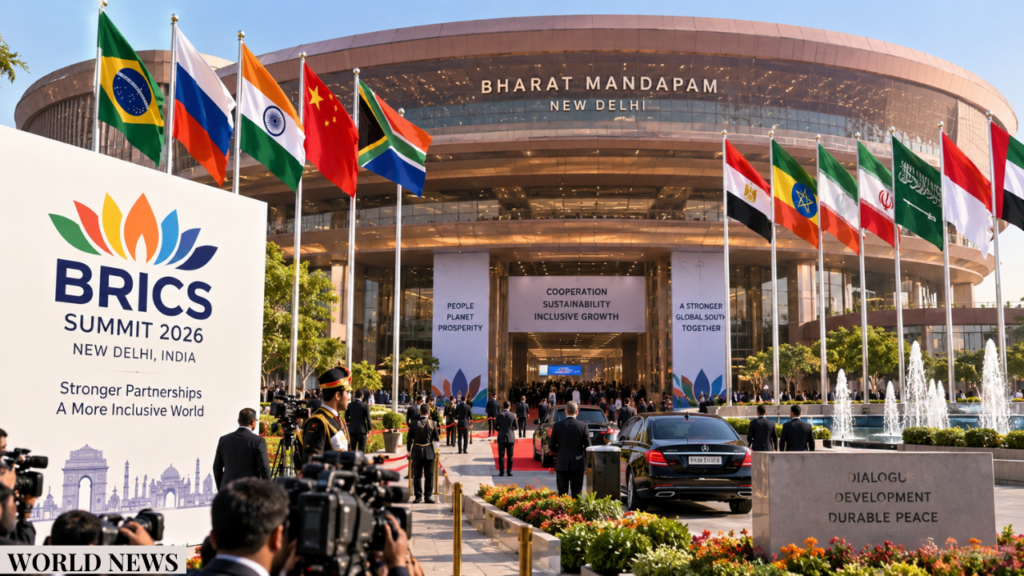
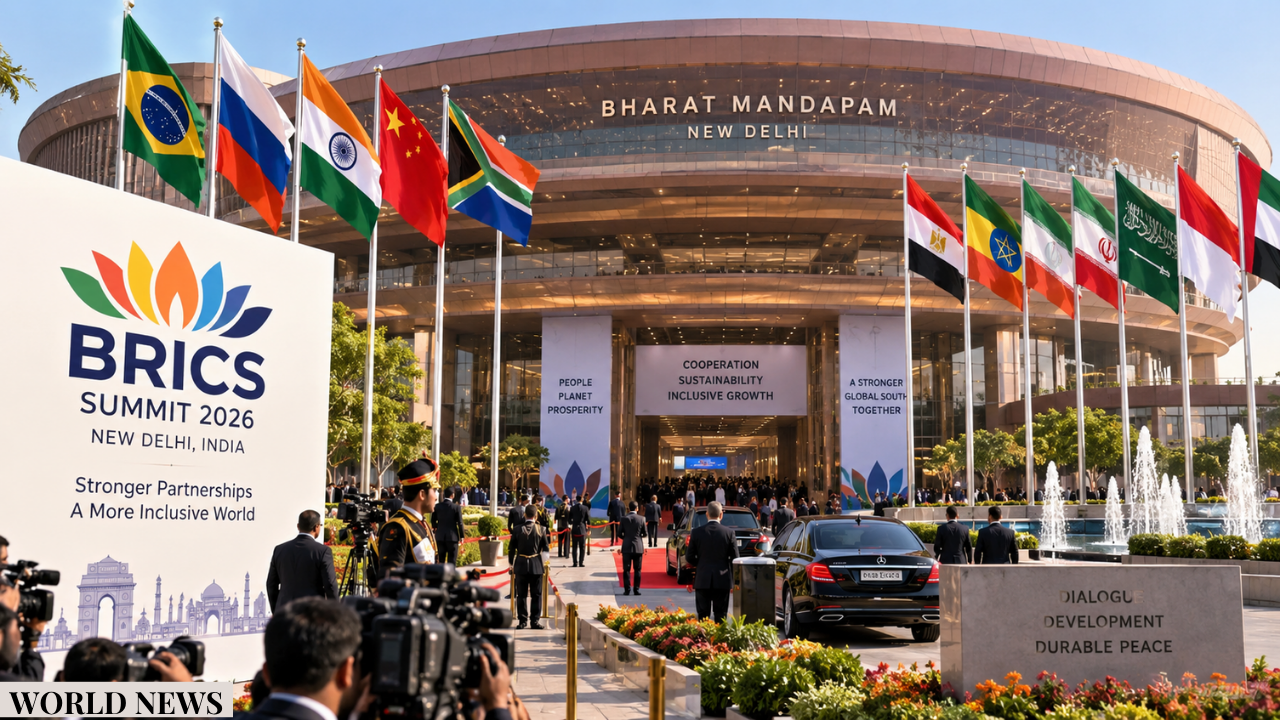
New Delhi, India — September 12, 2026: India is hosting the 18th BRICS Summit in New Delhi on September 12–13, bringing together leaders and representatives of the expanded 11-member group as wars, energy disruptions, trade pressures and tensions involving the United States test the bloc’s ability to maintain a common position on major global issues.
The summit, being held at Bharat Mandapam, comes as the Middle East conflict continues to affect energy markets and trade routes, while Russia’s war in Ukraine and broader U.S.-China tensions add to the geopolitical challenges facing BRICS.
India, which holds the group’s 2026 chairmanship, has placed resilience, innovation, cooperation and sustainability at the center of its agenda. The Indian government says the chairmanship is intended to strengthen practical cooperation while giving greater weight to the interests of the Global South.
The summit also carries a significant test of internal unity. BRICS now includes major energy producers and countries with sharply different positions on the conflicts affecting the Middle East. Nevertheless, members have reached agreement on a joint declaration ahead of the leaders’ meeting, according to Reuters.
What Is BRICS?
BRICS began as a grouping of Brazil, Russia, India and China before South Africa joined in 2010. It has since expanded significantly.
The current 11-member grouping consists of Brazil, China, Egypt, Ethiopia, India, Indonesia, Iran, Russia, Saudi Arabia, South Africa and the United Arab Emirates. According to India’s Press Information Bureau, the members collectively account for about 49.5% of the world’s population, 40% of global GDP and 26% of global trade.
The expansion has increased BRICS’ economic and geopolitical weight, but it has also made consensus more difficult because members have different political interests, economic structures and relationships with Western powers.
Why the 2026 Summit Matters
The New Delhi meeting is taking place at a particularly difficult moment for the international economy.
The war involving Iran has disrupted energy flows and created additional pressure on shipping through the Strait of Hormuz, one of the world’s most important energy routes. Higher oil prices and uncertainty surrounding global trade have made energy security and supply-chain resilience important issues for BRICS governments.
The conflict also presents a diplomatic challenge because Iran is a BRICS member while the United Arab Emirates and Saudi Arabia are also part of the expanded grouping.
That means BRICS must attempt to find common language on a conflict involving countries inside the organization itself.
Reuters reported that the bloc’s members agreed on a joint declaration despite those divisions, describing the agreement as a test of BRICS’ ability to maintain unity.
Middle East Conflict Puts BRICS Unity Under Pressure
Iran’s participation is one of the most closely watched aspects of the summit.
Iran became a BRICS member in 2024, adding another major energy-producing country to the group. President Masoud Pezeshkian is attending the New Delhi summit, while India’s Prime Minister Narendra Modi met with him on September 11.
According to India’s Press Information Bureau, Modi and Pezeshkian discussed developments in West Asia. Modi reiterated India’s position that disputes should be addressed through dialogue and diplomacy and emphasized the importance of freedom of navigation, commerce and the safety of seafarers.
The issue is particularly significant for BRICS because disruptions to energy and shipping routes can affect economies far beyond the countries directly involved in the conflict.
Energy Security and Oil Prices Are Key Concerns
Energy security is another major issue at the summit.
The Strait of Hormuz carries a substantial share of globally traded oil and other energy products. Disruptions there can quickly affect transportation costs, fuel prices and inflation in countries that depend on imported energy.
BRICS’ expanded membership includes several major energy producers, giving the group an important role in discussions about energy security.
At the same time, the members do not have identical economic interests. Some are major exporters, while others depend heavily on imports. That makes coordination on energy policy potentially valuable but politically complicated.
Trade and Critical Supply Chains
The summit is also expected to focus on economic cooperation, investment, technology, food security, health, disaster resilience and critical supply chains.
India has emphasized practical cooperation rather than simply expanding the group’s political profile.
Among the initiatives being advanced during India’s chairmanship are proposals involving startup cooperation, innovation networks and logistics and supply-chain collaboration. These efforts are intended to improve connections among businesses and institutions across BRICS countries.
Supply-chain resilience has become increasingly important as geopolitical conflicts and disruptions to major transportation routes affect international commerce.
India Pushes for Changes to Global Institutions
India is also using its BRICS chairmanship to press for reforms to international institutions.
New Delhi has repeatedly argued that developing and emerging economies should have greater representation in institutions that shape global economic and political decisions.
Prime Minister Narendra Modi has called for reform of the United Nations Security Council and greater representation for emerging economies in global governance. Reporting from the summit indicates that institutional reform remains a central theme of India’s BRICS agenda.
The broader objective is to give the Global South a stronger voice in international decision-making.
U.S. Relations Add Another Layer of Tension
BRICS is not formally an anti-American alliance, and its members have different relationships with Washington.
India maintains extensive economic and strategic ties with the United States while also maintaining important relationships with Russia and other BRICS members.
China, meanwhile, remains in strategic and economic competition with the United States. Russia is under extensive Western sanctions because of its war in Ukraine, while Iran has longstanding tensions with Washington.
Those differences make it difficult to treat BRICS as a single geopolitical bloc.
Instead, the organization increasingly functions as a platform where countries with different interests seek areas of common ground.
India Balances Russia, China and the West
The summit also highlights India’s complicated diplomatic position.
India has strengthened relations with the United States and other Western countries while maintaining longstanding defense, energy and diplomatic ties with Russia.
China is another important factor.
Relations between India and China have experienced periods of tension, although recent diplomatic engagement has sought to stabilize bilateral relations. The two countries remain major economic powers within BRICS, making their relationship important to the organization’s future direction.
The New Delhi summit therefore gives India an opportunity to demonstrate its preference for strategic autonomy while managing relationships with competing global powers.
What Leaders Are Expected to Discuss
The summit agenda includes several major areas:
- Global governance and multilateralism
- International peace and security
- Trade and investment
- Energy security
- Food security
- Health cooperation
- Technology and innovation
- Disaster resilience
- Critical supply chains
- Sustainable development
- Greater cooperation among developing economies
India’s official theme is “Building for Resilience, Innovation, Cooperation and Sustainability.”
The summit’s first major leaders’ session on September 12 focuses on inclusive global governance and strengthening multilateralism, while the main session on September 13 is centered on resilience, innovation, cooperation and sustainability.
A Test of Whether BRICS Can Move Beyond Symbolism
The biggest question facing the expanded bloc is whether its growing membership can translate into practical cooperation.
BRICS represents a substantial share of the world’s population and economy, but its members have competing interests on wars, trade, energy and relations with Western countries.
That diversity can make consensus difficult.
At the same time, the agreement on a joint declaration before the summit demonstrates that members can still find common ground despite serious disagreements, according to Reuters.
For India, the immediate objective is therefore not simply to present BRICS as a rival to Western institutions. It is to demonstrate that a diverse group of emerging economies can cooperate on issues affecting the global economy.
The outcome of the New Delhi summit could help determine how effectively BRICS can turn its expanding economic weight into coordinated diplomatic and economic influence.
FAQ Section
What is the BRICS Summit 2026?
The BRICS Summit 2026 is the annual leaders’ meeting of the expanded BRICS group. India is hosting the 18th summit in New Delhi on September 12–13, 2026.
Which countries are members of BRICS in 2026?
BRICS has 11 members: Brazil, China, Egypt, Ethiopia, India, Indonesia, Iran, Russia, Saudi Arabia, South Africa and the United Arab Emirates.
Where is the 2026 BRICS Summit being held?
The summit is being held at Bharat Mandapam in New Delhi, India.
What is India’s theme for the 2026 BRICS Summit?
India’s BRICS chairmanship is guided by the theme “Building for Resilience, Innovation, Cooperation and Sustainability.”
What issues are BRICS leaders discussing?
The agenda includes global governance, trade, investment, energy and food security, technology, health, disaster resilience, sustainable development and critical supply chains.
Why is the Middle East conflict important to BRICS?
The conflict has affected energy markets and shipping routes while creating political divisions among BRICS members, including Iran, the UAE and Saudi Arabia. This makes the issue a significant test of the bloc’s ability to reach consensus.