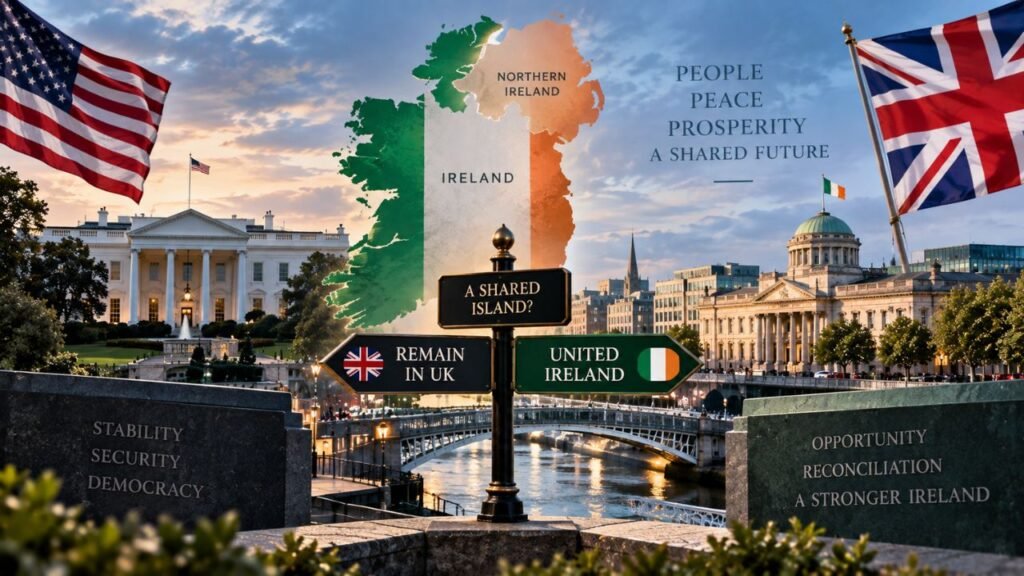
DUBLIN, Sept. 12, 2026 — U.S. President Donald Trump said during a visit to Dublin on Saturday that he would “love” to see Northern Ireland become part of a united Ireland, putting the issue of Irish unity back into the international spotlight while the British government maintained that its position on a possible referendum has not changed.
Trump made the comments after meeting Irish Prime Minister Micheál Martin in Dublin. He said he believed Irish unification would eventually happen, while acknowledging that the United Kingdom would have a role in the constitutional process.
“I’d love to see it unified,” Trump told reporters alongside Martin. He added that he believed it would happen “eventually” and described unification as something he considered positive.
The comments drew a response from unionist politicians in Northern Ireland, while the office of British Prime Minister Andy Burnham said the government’s position remained unchanged.
Trump Raises Irish Unity During Dublin Visit
Trump’s remarks came during a two-day visit to Ireland that included meetings with senior Irish officials and a later trip to his golf resort in Doonbeg, County Clare, where he was due to attend the Irish Open.
During his meeting with Martin, Trump said he did not want to create problems but made clear that he favored the prospect of a united Ireland.
He also acknowledged that the United Kingdom would have a say in the matter.
Trump separately met Irish President Catherine Connolly during the visit. The trip combines diplomatic engagements with Trump’s attendance at the golf tournament at his Doonbeg resort.
UK Government Says Its Position Has Not Changed
Trump’s comments do not alter the UK’s constitutional or legal arrangements concerning Northern Ireland.
The office of Prime Minister Andy Burnham said Saturday that his position on Irish unity remained unchanged.
Burnham had told lawmakers earlier in the week that he was not aware of majority public support for another referendum and that there would not be one unless that situation changed.
“I am not aware that there is majority public support for another referendum, and until that changes, there will not be one,” Burnham said, according to Reuters.
The prime minister’s office subsequently confirmed that his remarks still stood following Trump’s comments.
What the Good Friday Agreement Says
The constitutional status of Northern Ireland is governed by the principle of consent established by the 1998 Belfast Agreement, commonly known as the Good Friday Agreement.
The agreement provides that Northern Ireland’s constitutional position cannot change without the consent of a majority of its people. It also established arrangements for a possible border poll on whether Northern Ireland should remain in the United Kingdom or become part of a united Ireland.
Under the Northern Ireland Act 1998, the UK secretary of state for Northern Ireland has the power to call such a poll. The House of Commons Library says the secretary of state must call one if it appears likely that a majority of people in Northern Ireland would vote for Irish unification.
A successful constitutional change would also require support in the Republic of Ireland under the arrangements established by the 1998 agreement.
Unionists Reject Trump’s Prediction
Trump’s comments were rejected by unionist politicians who support Northern Ireland remaining part of the United Kingdom.
Gavin Robinson, leader of the Democratic Unionist Party, said Northern Ireland’s constitutional future should be determined by people in Northern Ireland rather than by political commentary from outside the region.
The reaction reflects the longstanding division over Northern Ireland’s constitutional status, with unionists generally supporting continued membership of the United Kingdom and nationalists generally supporting Irish unification.
The Good Friday Agreement was designed to provide a constitutional framework based on consent while supporting power-sharing and political stability after decades of conflict.
A Long-Running Constitutional Question
The question of Irish unity has remained part of Northern Ireland’s political debate since the 1998 agreement.
The legal framework does not provide for a referendum simply because a foreign leader or political party calls for one. Instead, the decision to hold a border poll rests within the framework established by the Northern Ireland Act and the Good Friday Agreement.
The UK government reiterated in a parliamentary answer in July that Northern Ireland would remain part of the United Kingdom for as long as its people wished it to and that responsibility for calling a border poll rests with the secretary of state for Northern Ireland.
US Role in the Northern Ireland Peace Process
Trump’s comments also attracted attention because of the longstanding American role in the Northern Ireland peace process.
The United States played an important role in supporting the negotiations that produced the 1998 Good Friday Agreement. Previous U.S. presidents have generally avoided taking a direct position on the constitutional outcome, according to Reuters.
Trump’s remarks therefore represent a notable public statement by a sitting U.S. president on the question of Irish unity, although they do not themselves initiate any constitutional process.
What Happens Next?
For now, the immediate position remains unchanged.
The British government says it does not currently consider the conditions for another Northern Ireland border poll to have been met, while the legal framework continues to provide a mechanism for a referendum if the required conditions arise.
Trump’s comments have nevertheless placed renewed international attention on an issue that remains politically sensitive in Northern Ireland and across the island of Ireland.
Any future change to Northern Ireland’s constitutional status would have to proceed through the legal and democratic mechanisms established under the Good Friday Agreement and UK law.
FAQ section
Could Trump’s comments trigger a referendum on Irish unity?
No. Trump’s comments do not themselves trigger a referendum. Under the existing legal framework, the decision to call a border poll rests with the UK secretary of state for Northern Ireland, subject to the conditions established by the Northern Ireland Act 1998.
What did Donald Trump say about a united Ireland?
During his meeting with Irish Prime Minister Micheál Martin in Dublin, Trump said he would “love” to see Ireland unified and said he believed it would happen eventually.
What is the UK government’s position?
The office of Prime Minister Andy Burnham said his position remained unchanged. Burnham has said there is currently no majority public support for another referendum and that there would not be one unless that changed.
What is a border poll?
A border poll is a referendum on whether Northern Ireland should remain part of the United Kingdom or join the Republic of Ireland in a united Ireland.
What does the Good Friday Agreement say about Irish unity?
The agreement establishes the principle of consent, meaning Northern Ireland’s constitutional status can change only with the consent of a majority of its people.